Reedeming Pinchas: Repairing the Irreparable

“Phineas Slayeth the Celebrants” (Avi Katz)

Here’s the story of Pinchas, title character of this week’s Torah portion:

While sojourning in Shittim, the Israelites profane themselves by consorting with Moabite women who invite them to make sacrifices to their god. Incensed, God orders Moses to have all the ringleaders impaled – but just as Moses issues the order, an Israelite chieftain and a Midianite princess cohabit in full view of the Israelite community.

In response, Pinchas, (the grandson of Aaron the High Priest) steps forward and stabs both of them through the belly, thus saving the Israelites from a plague (which had resulted, presumably, from God’s wrath.)  God extols Pinchas for his zealousness and grants him and his descendants a “covenant of peace” (brit shalom) – a pact of priesthood for all time.

Horrified? I don’t blame you. There’s no use sugar coating it: this week’s Torah portion sanctions xenophobia, intolerance, and murderous religious zealotry.

Still, over the centuries, some commentators have had a field day with Parashat Pinchas, attempting to somehow redeem the inherent nastiness of the story. According to the Talmud, for instance, if Pinchas had asked the rabbinical court to legally sanction his killing, the court would have responded, (in true Talmudic fashion), “the law may permit it, but we do not follow that law!” (BT Sanhedrin 82a)  The Chatam Sofer (Hungary, 19th c.) views God’s pact of priesthood with Pinchas less as a reward for his zealousness than as a corrective to it: “(Pinchas) will have to cure himself of his violent temper if he is to function as a priest.” (Eytz Hayyim, p. 918)  In a contemporary reading of the portion, Rabbi Arthur Waskow suggests that Pinchas’ extreme actions shocks God into an act of teshuvah (repentance), causing God to end the deadly plague and pursue a covenant of peace.

While I’m taken by the exegetical brilliance of some of these interpretations, I confess that none of them really solve the essential problem for me. At the end of the day, I’m not sure that any interpretation, no matter how intellectually dazzling, can compete with the raw, literal power of a story that promotes murderous zealotry in God’s name. Or to put it in neurological terms: I’m not sure that the intellectual, left brain approach to Pinchas can ever truly redeem what is essentially a visceral, lizard-brain story. On the contrary, when we try too hard to explain away the more disturbing elements of Torah, we sometimes end up doing the exact opposite: words upon words of interpretation often merely shine a light on these troubling elements all the more.

In contrast to the countless pages of commentary generated by this story, the most redemptive interpretation I know actually comes in the form of one tiny letter. In the Masoretic text of the Torah scroll, the word “Shalom” in the term “brit shalom” is written with a broken letter vav. (Vav, of course, is also one of the letters in God’s name, YHVH.)

For me, at least, this still, small suggestion of irreparable brokenness says more than a thousand words of commentary. In one short pen stroke, the message is driven home: this broken “covenant of peace” is no peace at all. This broken God that requires murderous zealotry of humanity is no God at all. No rationalizing, no explaining away can truly repair the essential brokenness of this story.

Yes, perhaps this one letter is all the interpretation we need: certain stories, certain ideas, certain acts are simply too broken to be redeemed. And all the rest, as they say, is commentary…

Inner Jacob, Inner Israel

How fair are your tents, O Jacob/Your dwellings, O Israel! (Numbers 24:5)

These words, uttered by the ersatz prophet Balaam in praise of the Israelites, come from this week’s Torah portion, Balak, but are best known as the opening line of the well-known morning prayer, “Mah Tovu.”

If you read this verse carefully, you’ll notice that it essentially expresses the same idea twice, using different words and images. Literarily speaking, this is known as “a couplet,” and is considered a defining feature of Biblical poetry. Commenting on this phenomenon, Biblical literary scholar Robert Alter has observed that “there is a characteristic movement of meaning” from first half of the couplet to the second. (“The Art of Biblical Poetry,” p. 19)

Indeed, over the centuries Biblical commentators have parsed poetic verses by comparing the subtle differences between the first and second halves of a given couplet. In the case of this famous verse, the juxtaposition of Jacob with his “alter ego” Israel has given rise to some rich homiletical interpretation.

Reb Rachel Barenblat, for instance, offers this wonderful insight:

In this synechdoche, the patriarch symbolizes the whole. Jacob is the earthly, embodied side of the patriarch, the aspect that inhabits physical spaces. Israel is the other side of the coin, the part of the patriarch which wrestled with the angel of God and came away blessed. Where Jacob has tents, Israel has dwellings — in Hebrew, Israel has mishkanot, like the holy dwelling-place of the indwelling Shekhinah.

Each of us is both Jacob and Israel; we have Jacob-ness and Israel-ness in ourselves. And each of us can make the leap from inhabiting a tent to inhabiting a dwelling-place. When we wrestle and dance and dream with Torah, we transform ourselves from worldly Jacob to engaged Israel, and we embody Balaam’s blessing.

For my part, I find myself returning to the image of Jacob as “wanderer.” In his childhood, he is described as “ish tam yoshev ohalim” – “a simple man who dwelt in tents.” (Genesis 25:27) Tents are by their nature temporary dwellings; and indeed Jacob will eventually spend most of his life wandering/fleeing/returning/departing.

The name Israel, on the other hand, represents “home.” Even in the midst of his wanderings, Jacob/Israel will experience reconciliation (with his brother Esau), reunion (with his son Joseph) and at the end of his life, homecoming, when he is taken from Egypt and buried in the cave of his ancestors: “he drew his feet into the bed and, breathing his last, he was gathered to his people.” (Genesis 49:33)

As Reb Rachel points out, both Jacob and Israel are indelibly imprinted upon our spiritual psyches. We are forever setting out and we are forever coming home – life is an endless cycle of wandering and homecoming. And so it must be: if it were exclusively the former, we’d be eternally lost; if only the latter, our spiritual lives would become complacent and stagnant.

Here, then, is yet another way to understand Balaam’s blessing: that we may experience the divine presence in our going forth and in our coming home.

Ashes to Ashes: Red Heifer as “Spiritual Equilibirum”

This week’s Torah portion begins with a description of the infamous red heifer – that most inscrutable of all ancient Israelite sacrifices. Generation after generation of commentators have puzzled over the meaning of this mysterious ritual, which seems to defy rational explanation at every turn.

According to our portion, a “red cow without blemish” must be burned together with cedar wood, hyssop, and crimson stuff to purify anyone who comes into contact with a corpse. (Numbers 19:11-19)  While this essentially is a sacrifice prescribed for those who have become ritually impure, we also read that the priests who facilitate the sacrifice actually become impure themselves through their contact with the heifer’s ashes – and must then undergo their own rituals of purification. (Numbers 19:7-10, 19:21-22)

What on earth do we make of sacrifice that makes the impure pure, but in so doing renders the pure impure?

Let’s look first at the ingredients of the sacrifice. Symbolically speaking, it’s noteworthy that both hyssop and cedar are used – as both have been historically connected with healing, cleansing and protection. Among their Biblical associations, hyssop was famously used to mark the Israelites’ doorposts with blood in Egypt, and cedar wood was a central material used in the building of the Temple in Jerusalem.

At the same time, however, these plants are polar opposites: the hyssop is a lowly shrub associated with humility while the cedar is a massive, towering tree that commonly represents majesty and pride.

The color red, of course, has many popular associations. Generally speaking, red symbolizes love, sensuality, emotion and passion. Red is also the color of blood and fire, both of which are central to life itself.  As the primary color of the sun, it is associated with the life-giving energy that animates our world.

The 16th century Italian Torah commentator Sforno famously interpreted the red of the red heifer to represent emotion or passion taken to an unhealthy extreme – and that the symbols of hyssop and cedar indicate that one can engage in unhealthy extremes in either direction: humility/self-abnegation or pride/ego.

To further paraphrase Sforno, the ashes of the red heifer serve as a kind of “extreme ritual therapy” designed to help someone who dwells in the extremes to attain the “golden mean” – or a place of spiritual equilibrium.  However, in order to facilitate this ritual, the priest must themselves go into those extreme places himself – and in so doing, his own equilibrium will be affected. That is why the Torah prescribes a rite of “purification” for the “purifier” as well.

In answering the puzzling question of the red heifer ritual, then, we’ve given rise to yet deeper questions:

–  In what ways do we find ourselves charting more extreme terrain – and to what extremes must we go to return to balance and equilibrium?

– What must we do to help others who might inhabit this territory – and what must we do for ourselves to find our way back?

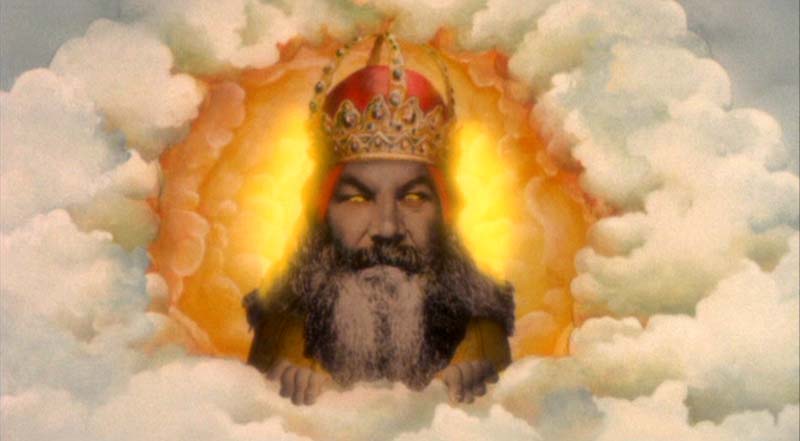
God Has Anger Management Issues

Angry God (courtesy of Monty Python)

In this week’s Torah portion, Korach ben Yitzhar foments a rebellion against Moses and Aaron. At the height of the mutiny, Korach gathers “the whole community against them at the entrance of the Tent of Meeting.” (Numbers 16:19)

The text continues:

Then the Presence of the Lord appeared to the whole community, and the Lord spoke to Moses and Aaron, saying, “Stand back from this community that I may annihilate them in an instant!” But they fell on their faces and said, “O God, Source of the breath of all flesh! When one man sins, will You be wrathful with the entire community?” (16:19-22)

I’m struck by a few things here:

This passage is, of course, powerfully reminiscent of another famous episode – namely, when Abraham challenges God not to engage in collateral damage during the destruction of Sodom and Gomorrah:

Will You sweep away the innocent along with the guilty? What if there should be fifty innocent within the city; will You then wipe out the place and not forgive it for the sake of the innocent fifty who are in it? Far be it for you to bring death upon the innocent as well as the guilty, so that the innocent and the guilty fare alike. Far be it from You! Shall not the Judge of all the earth deal justly?” (Genesis 18:22-25)

And this isn’t even the first time God angrily threatens to completely wipe out the Israelites themselves (see, for instance, Exodus 32:9-10 and Numbers 14: 11-12). Then, as well as here, Moses has to talk God off the ledge, so to speak.

It’s certainly more than a bit curious that God, who is elsewhere described as “a God compassionate and gracious; slow to anger, abounding in kindness and faithfulness” (Exodus 34:6) is repeatedly portrayed with an exceedingly explosive temper and serious anger management issues. It’s also a curious role reversal: a mere mortal is put in the position of reminding God to behave (and God repeatedly relents!)

What should we make of all this? As for me, as I’ve indicated before, I prefer not to read Biblical descriptions of God as theological treatises, but rather as powerful projections of our human struggles onto the image of God. (So you mean to tell me that you’re confused that God appears alternatively “compassionate” and “jealous,” “forgiving” and “vengeful?” Well, duh – God is only human after all…)

When I read these human – divine interactions, I can’t help but think about the ways in which we struggle internally with our ever-present penchant for all-consuming anger and destructiveness. Sometimes, à la Abraham, it means grappling with the inherent justice of our actions. Other times, as in the aftermath of the Golden Calf episode, our anger might back down in the face of our inner pride and shame.

I find this week’s struggle particularly powerful. By addressing God as “Source of breath of all flesh,” Moses and Aaron remind God/us that the very breath we breathe is a sacred essence that we share with all that lives. Whenever we allow ourselves to become consumed by our anger, our sense of this divine unity becomes fundamentally disrupted.  But if we understand that our breath is not ours to breathe alone, we experience our connection to the “Source of the Breath of All Flesh” – and we may well regain our physical/spiritual equilibrium.

(Could this be why breathing exercises have long been considered a time-honored method for dealing with anger management? Just sayin’…)

On Sticks and Stones

From this week’s Torah portion, Shelach Lecha:

Once, when the Israelites were in the wilderness, they came upon a man gathering wood on the sabbath day. Those who found him, as he was gathering wood brought him before Moses, Aaron and the whole community. He was placed in custody, for it had not been speculated what should be done to him. Then the Lord said to Moses, “The man shall be put to death: the whole community shall pelt him with stones outside the camp.” So the whole community took him outside the camp and stoned him to death – as the Eternal had commanded Moses. (Numbers 15:32-36)

Yeah, this is a tough one.

So here’s my take: it isn’t God who hands down the death sentence upon this poor guy at all.

How can I say this? I say this because I believe the Torah to be a document written wholly by human authors – many different authors over a very long period of time. And as a composite document primarily concerned with God’s role in history and human society, it reflects many different voices that run a spectrum from our loftiest spiritual/ethical yearnings to our darkest and basest human impulses.

For those who are aghast that God could command such a heinous punishment for such a mild offense, here is the only answer I know to offer: this ain’t God. This is a description of an act of collective religious zealotry attributed to God by the Biblical author. A classic example of mob mentality in action.

Having said that, it’s not as if we don’t learn important lessons from this episode.  I’m struck by a few things in particular:

I’m struck that the community isn’t all that sure what to do with the wood-gatherer after they capture him. It is notable that God had not previously specified gathering sticks as a Shabbat prohibition. Perhaps they were concerned that his actions fell into a grey area – that he was gathering sticks with the intention of kindling a fire (which is explicitly prohibited by Torah.)  In any case, this is certainly a moment of collective legal confusion for the Israelite community.

I’m also struck that this episode follows upon God’s pronouncement that as punishment for its faithlessness, this generation of Israelites will not be allowed to enter the land of Israel (“your carcasses will drop in this wilderness, while your children roam in the wilderness for forty years…” 14:32-33.) In other words, the stick-gathering incident occurs during a desperate and terrifying moment for the Israelite people.

And I’m also struck that while the question is brought before “Moses, Aaron and the whole community,” it is God who renders the final verdict.  In my reading of this passage, however it is not God handing down the heinous sentence – God is merely a literary “stand-in” for a fearful and confused people who have resorted to mob behavior for unacceptable (if perhaps understandable) reasons.

While this episode has nothing to teach us about Shabbat observance, it still teaches us plenty about the dynamics of collective fear – and the cruelty with which we too often inflict our fear upon others…

…and maybe, just maybe, it is also a lesson about the ways we too often project our fear and cruelty onto God.

Race and Infection

In this week’s Torah portion, Parashat Beha’alotecha, Aaron and Miriam unexpectedly disparage their brother Moses:

When they were in Hatzerot, Miriam and Aaron spoke against Moses because of the Cushite woman he had married: “He married a Cushite woman!” (Numbers 12:1)

Moses’ siblings’ slur is confusing on a number of levels. In the first place, it’s not quite clear who this “Cushite woman” actually is. Cush is commonly understood to refer to ancient Ethiopia (in Genesis 10:6 we read that the Cushites descended from Ham, the son of Noah.) However, Moses’ wife Zipporah is a Midianite, not a Cushite.

Commentators have handled this discrepancy in different ways. Some suggest that Zipporah and the Cushite woman are the same person. (Pointing out that Habbakuk 3:7 refers to a Midianite tribe called Cushan). Other Biblical scholars posit that the reference to the Cushite wife is a fragment of a larger literary tradition that has since gone the way of history.

These theories are interesting as far as they go, but in the end they fail to address the most troubling dimension to this episode: namely, the patently racist nature of Miriam and Aaron’s words.

Indeed, whatever else might be going on in this cryptic Biblical narrative, it might be, at least in part, an anti-racist polemic. After her unabashedly xenophobic exclamation “He married a Cushite woman!” it is more than a bit ironic that Miriam is stricken with tzara’at – a skin affliction that manifests itself with “snow-white scales.” (12:10) In a sense, God seems to be saying to Miriam: “You like white so much, I’ll show you white!”

Classical Jewish commentators famously understand tzara’at to be a physical manifestation of the sin of lashon harah – negative speech, or gossip. For myself, I’ve always found this interpretation to be less compelling as theology (i.e. illness is a result of divine punishment) than as a metaphor for the virulent nature of hate speech. I would prefer to say it this way: Miriam’s malady is not literally caused by her words; rather, her infectious tzara’at mirrors the inner properties of her racist words themselves.

Alas, we know this to be all too true: hate speech can be fatally infectious. Left unchecked, racism almost invariably spreads virally through society. Centuries after these Biblical words were written, hateful words continue to mutate into racist attitudes and actions in new and frightening ways.

Facing God, Facing One Another

This week’s Torah portion, Parashat Naso, contains what is possibly the most well-known extant blessing in Biblical tradition: the Birkat Cohenim or “Priestly Blessing:”

May ADONAI bless and protect you. May ADONAI shine (God’s) face upon you show favor to you. May ADONAI turn (God’s) face to you and grant you peace. (Numbers 6:23-26)

One of the most notable aspects of this blessing is its metaphorical use of “God’s face.” The final two blessings utilize this image in two different ways: in the second blessing, the “light” of God’s countenance bestows acceptance or grace (in Hebrew, chen); in the third and final blessing, the “turning” of God’s face expresses Shalom – peace, wholeness, fulfillment.

The metaphor of God’s face is used throughout the Bible, often to convey the powerful and immediate experience of the Divine Presence. In the closing verses of the Torah, for instance, Moses’ unique relationship with God underscored when we read that “God singled him out face to face” (Deuteronomy 34:10). On the other hand, the concept of hester panim (the “hiding of God’s face”) is often invoked to convey divine anger and punishment (see, for instance, Deuteronomy 31:18).

As poetic as these images may be, I personally struggle with their overly supernatural/anthropomorphic usages. I’m much more drawn to poignantly humanistic way “God’s face” is invoked during the reconciliation of the estranged twin brothers Jacob and Esau.

Upon their reunion, Jacob says to his older brother:

Please, if you would do me this favor, accept from me this gift; for to see your face is like seeing the face of God… (Genesis 33:10)

This use of the metaphor suggests that Godliness is particularly manifest in the act of conflict resolution – when former enemies find the wherewithal to “turn their faces” to one another. In this regard, we might well view the Birkat Cohenim not merely as a blessing of well-being but as a spiritual imperative to all who receive it.

When does God’s face shine upon us or turn to greet us? When we turn our faces to one another in acceptance and peace.

Voices in the Wilderness

As we begin Parashat Bamidbar – the first portion in the book of Numbers – we read:

God spoke (vaydaber) to Moses in the wilderness (bamidbar).

I’ve often been interested in the fact that the Hebrew verb “to speak” and the word for “wilderness” share a common root: d-b-r.  It suggests an important connection between wilderness and speech – more specifically divine speech.

There are, in fact, numerous Biblical descriptions of Godly encounter that take place in a deep wilderness setting. Before Moses discovers the burning bush, for instance, he drives his flock “achar hamidbar” – “beyond the wilderness.” Not long after the Exodus, the Israelites experience a communal revelation at Sinai after they had “encamped in the wilderness” (Exodus 19:2)  And in 1 Kings 19, the prophet Elijah encounters the still, small voice of God after traveling “bamidbar derech yom” – “a day’s journey into the wilderness.”

It isn’t difficult to understand why the desert habitat is considered sacred by so many Western, Eastern and indigenous spiritual traditions. At first glance, the wilderness might seem to be a wasteland – a “God-forsaken” environment unable to support life. But desert biomes are actually vital, and dynamic ecosystems teeming with a wide array of geological variety as well as significant plant and animal biodiversity. In other words, the desert invites us to look beyond its seemingly barren surface to discover the life that dwells deep within.

We also might regard the wilderness as more symbolic terrain – an existential place far from the “noise” of culture, artifice and ego. Indeed, this form of spiritual experience is available even to non-desert dwellers: a mindfulness or way of life that seeks to strip away the outer layers of self so we may discover, like the ancient Israelites, the divine word that dwells at the elemental core.

In the end, the journey into the wilderness is one that leads both inward and outward: to the outermost reaches of experience and the innermost reaches of the human soul. These are the places where the voice of God may truly be heard.

On the Curse of a Windblown Leaf

As for those of you who survive, I will cast a faintness in their hearts in the land of their enemies. The sound of a windblown leaf will put them to flight. Fleeing as though from the sword, they shall fall though none pursues (Leviticus 26:36).

This verse, which comes from this week’s Torah portion, Bechukotai, is one of the many vivid curses threatened by God if the Israelites should disobey the commandments (a litany that is lovingly referred to by Biblical scholars as “The Execration.”)

I’m particularly struck that among all of the worst execrable curses God can name, comes this psychologically resonant image of a people whose anxiety is so intense that they will flee at the very slightest of triggers. Based on the description of such “symptoms,” we might well call this verse a Biblically ordained “panic attack.”

For comparison purposes, check out this excerpt from the web article, “How to Identify Signs of a Panic Disorder.” (Just go with me for a second here):

Pay attention to your emotions and feelings at any time of stress or worry. Are you ready to run at the slightest sound? Do you sense fear or impending doom or an overwhelming sense of dread? Such fears only provoke more fears and often lead individuals to feel like they’re going crazy. If you have such symptoms, schedule a visit with your physician to discuss possible causes and potential treatments.

See what I mean?

Of course even if we do accept the parallels, many of us would find a theology that views psychological disorders as divine punishment to be utterly unacceptable (or at least not particularly comforting.) I prefer to think that the exact opposite is true: God is not the “cause”, but the “solution.” God does not punish us with the pain of stress and anxiety; God is the source of healing to which we turn.

In a recent article for the LA Times, writer Margaret Finnegan described the severe panic attacks she experienced when her five year old daughter was first diagnosed with epilepsy. After a several attempts to alleviate her panic through therapy, exercise and medication, she explained,

…I needed to change. I couldn’t be a constant yo-yo mirroring everyone else’s health. I needed to be strong in myself.

So I did the smartest thing I ever did: I started meditating. I’ve been doing Vipassana meditation for about three years now.

In Vipassana, we focus on the breath. When we realize our minds have wandered, we go back to the breath. In that moment, we “wake up.” We practice mindfulness. And, funny enough, after a while, you start “waking up” in daily life too.

Now, when my mind starts to spin out tragedies or dwell on past dramas, I’m less likely to get stuck in them. I wake up. When the stress of parenting a chronically ill child ratchets up, I take solace in the fact that my hardships are like each breath: They evolve. They pass. Nothing lasts forever.

As I read her words about the healing power of breathing mediation, I couldn’t help but be reminded of a well-known theological image from the Torah, namely:

(YHVH) blew into his nostrils the breath of life (“nishmat chayyim“) and man became a living being. (Genesis 2:7)

Now here is a powerful antidote to the image of a God that sends down panic attacks as punishment for our disloyalty: the God to whom we turn in our darkest, most panicked moments: the divine power embodied by nishmat chayyim: the healing breath of life itself.

We Are All Strangers Here

“But the land must not be sold beyond reclaim, for the land is Mine; you are but strangers resident with me.” (Leviticus 25:23)

In this verse, which comes from this week’s Torah portion Behar, God makes it clear to the Israelites that the land they are about to enter is not to be sold in the conventional manner. God is the ultimate “owner” of the land – thus the Israelites are cautioned they cannot treat it as private property. The Israelite residents are akin to resident aliens who are entrusted with the use of the land; however, since land was going to be “bought” and “sold,” this verse prohibits any purchase or sale to the exclusion of a claim of ownership

The land in Mine and you are but resident aliens…  The land, this earth, the very ground upon which we make our homes, does not ultimately belong to us. We are but strangers upon it – or at best we’re merely “leasing” it temporarily from God.  In just about every respect, this is truly a radical teaching. Indeed, if we broaden our understanding of this commandment beyond the milieu of Ancient Israel, it certainly carries a myriad of powerful economic, political and environmental implications.

It also has profound spiritual significance as well. In the words of Madeleine L’Engle:

We are all strangers in a strange land, longing for home, but not quite knowing what or where home is. We glimpse it sometimes in our dreams, or as we turn a corner, and suddenly there is a strange, sweet familiarity that vanishes almost as soon as it comes.