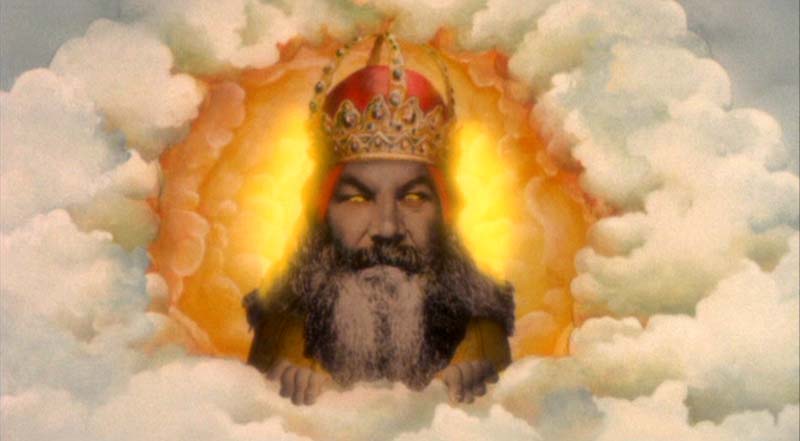
God Has Anger Management Issues

Angry God (courtesy of Monty Python)

In this week’s Torah portion, Korach ben Yitzhar foments a rebellion against Moses and Aaron. At the height of the mutiny, Korach gathers “the whole community against them at the entrance of the Tent of Meeting.” (Numbers 16:19)

The text continues:

Then the Presence of the Lord appeared to the whole community, and the Lord spoke to Moses and Aaron, saying, “Stand back from this community that I may annihilate them in an instant!” But they fell on their faces and said, “O God, Source of the breath of all flesh! When one man sins, will You be wrathful with the entire community?” (16:19-22)

I’m struck by a few things here:

This passage is, of course, powerfully reminiscent of another famous episode – namely, when Abraham challenges God not to engage in collateral damage during the destruction of Sodom and Gomorrah:

Will You sweep away the innocent along with the guilty? What if there should be fifty innocent within the city; will You then wipe out the place and not forgive it for the sake of the innocent fifty who are in it? Far be it for you to bring death upon the innocent as well as the guilty, so that the innocent and the guilty fare alike. Far be it from You! Shall not the Judge of all the earth deal justly?” (Genesis 18:22-25)

And this isn’t even the first time God angrily threatens to completely wipe out the Israelites themselves (see, for instance, Exodus 32:9-10 and Numbers 14: 11-12). Then, as well as here, Moses has to talk God off the ledge, so to speak.

It’s certainly more than a bit curious that God, who is elsewhere described as “a God compassionate and gracious; slow to anger, abounding in kindness and faithfulness” (Exodus 34:6) is repeatedly portrayed with an exceedingly explosive temper and serious anger management issues. It’s also a curious role reversal: a mere mortal is put in the position of reminding God to behave (and God repeatedly relents!)

What should we make of all this? As for me, as I’ve indicated before, I prefer not to read Biblical descriptions of God as theological treatises, but rather as powerful projections of our human struggles onto the image of God. (So you mean to tell me that you’re confused that God appears alternatively “compassionate” and “jealous,” “forgiving” and “vengeful?” Well, duh – God is only human after all…)

When I read these human – divine interactions, I can’t help but think about the ways in which we struggle internally with our ever-present penchant for all-consuming anger and destructiveness. Sometimes, à la Abraham, it means grappling with the inherent justice of our actions. Other times, as in the aftermath of the Golden Calf episode, our anger might back down in the face of our inner pride and shame.

I find this week’s struggle particularly powerful. By addressing God as “Source of breath of all flesh,” Moses and Aaron remind God/us that the very breath we breathe is a sacred essence that we share with all that lives. Whenever we allow ourselves to become consumed by our anger, our sense of this divine unity becomes fundamentally disrupted.  But if we understand that our breath is not ours to breathe alone, we experience our connection to the “Source of the Breath of All Flesh” – and we may well regain our physical/spiritual equilibrium.

(Could this be why breathing exercises have long been considered a time-honored method for dealing with anger management? Just sayin’…)

Alt-Country Theology: A Tutorial

Check out two very divergent takes on grief and loss by two wonderful alt-country singers: “The Duel,” by Allison Moorer and  “God is in the Roses” by Roseanne Cash (from her brilliant album “Black Cadillac,” one of my favorites.)

Both are profoundly personal reflections on God after the death of a loved one. I’m deeply moved by both, even if they express bereavement with radically different emotions and points of view.

I’d love to hear reactions.

“The Duel”
by Allison Moorer

In this cemetery mist
Stands a newborn atheist
Even if you do exist
You’re far from almighty
Flesh and blood’s a sissy fist
Death’s a gold glove pugilist
And everyday it’s hit or miss
That’s what I believe

I stared at my polished shoes
In front of your wooden pews
Prayed and prayed don’t let me lose
What my heart adores
Are miracles old-fashioned news
No healing hands were ever used
Faithfulness was my excuse
Tell me what was yours

I don’t know how many rounds
Are left in me ‘til I stay down
And there’s no telling where I’m bound
But one thing I’m sure of
The king of kings has lost his crown
It’s buried here in marble town
In the god forsaken ground
With my only love

“God is in the Roses”
by Rosanne Cash

God is in the roses
The petals and the thorns
Storms out on the oceans
The souls who will be born
And every drop of rain that falls
Falls for those who mourn
God is in the roses and the thorns

The sun is on the cemetery
Leaves are on the stones
There never was a place on earth
That felt so much like home
We’re falling like the velvet petals
We’re bleeding and we’re torn
But God is in the roses and the thorns

I love you like a brother
A father and a son
It may not last forever and ever
But it never will be done
My whole world fits inside the moment
I saw you be reborn
God is in the roses
And that day was filled with roses
God is in the roses and the thorns

On Sticks and Stones

From this week’s Torah portion, Shelach Lecha:

Once, when the Israelites were in the wilderness, they came upon a man gathering wood on the sabbath day. Those who found him, as he was gathering wood brought him before Moses, Aaron and the whole community. He was placed in custody, for it had not been speculated what should be done to him. Then the Lord said to Moses, “The man shall be put to death: the whole community shall pelt him with stones outside the camp.” So the whole community took him outside the camp and stoned him to death – as the Eternal had commanded Moses. (Numbers 15:32-36)

Yeah, this is a tough one.

So here’s my take: it isn’t God who hands down the death sentence upon this poor guy at all.

How can I say this? I say this because I believe the Torah to be a document written wholly by human authors – many different authors over a very long period of time. And as a composite document primarily concerned with God’s role in history and human society, it reflects many different voices that run a spectrum from our loftiest spiritual/ethical yearnings to our darkest and basest human impulses.

For those who are aghast that God could command such a heinous punishment for such a mild offense, here is the only answer I know to offer: this ain’t God. This is a description of an act of collective religious zealotry attributed to God by the Biblical author. A classic example of mob mentality in action.

Having said that, it’s not as if we don’t learn important lessons from this episode.  I’m struck by a few things in particular:

I’m struck that the community isn’t all that sure what to do with the wood-gatherer after they capture him. It is notable that God had not previously specified gathering sticks as a Shabbat prohibition. Perhaps they were concerned that his actions fell into a grey area – that he was gathering sticks with the intention of kindling a fire (which is explicitly prohibited by Torah.)  In any case, this is certainly a moment of collective legal confusion for the Israelite community.

I’m also struck that this episode follows upon God’s pronouncement that as punishment for its faithlessness, this generation of Israelites will not be allowed to enter the land of Israel (“your carcasses will drop in this wilderness, while your children roam in the wilderness for forty years…” 14:32-33.) In other words, the stick-gathering incident occurs during a desperate and terrifying moment for the Israelite people.

And I’m also struck that while the question is brought before “Moses, Aaron and the whole community,” it is God who renders the final verdict.  In my reading of this passage, however it is not God handing down the heinous sentence – God is merely a literary “stand-in” for a fearful and confused people who have resorted to mob behavior for unacceptable (if perhaps understandable) reasons.

While this episode has nothing to teach us about Shabbat observance, it still teaches us plenty about the dynamics of collective fear – and the cruelty with which we too often inflict our fear upon others…

…and maybe, just maybe, it is also a lesson about the ways we too often project our fear and cruelty onto God.

Facing God, Facing One Another

This week’s Torah portion, Parashat Naso, contains what is possibly the most well-known extant blessing in Biblical tradition: the Birkat Cohenim or “Priestly Blessing:”

May ADONAI bless and protect you. May ADONAI shine (God’s) face upon you show favor to you. May ADONAI turn (God’s) face to you and grant you peace. (Numbers 6:23-26)

One of the most notable aspects of this blessing is its metaphorical use of “God’s face.” The final two blessings utilize this image in two different ways: in the second blessing, the “light” of God’s countenance bestows acceptance or grace (in Hebrew, chen); in the third and final blessing, the “turning” of God’s face expresses Shalom – peace, wholeness, fulfillment.

The metaphor of God’s face is used throughout the Bible, often to convey the powerful and immediate experience of the Divine Presence. In the closing verses of the Torah, for instance, Moses’ unique relationship with God underscored when we read that “God singled him out face to face” (Deuteronomy 34:10). On the other hand, the concept of hester panim (the “hiding of God’s face”) is often invoked to convey divine anger and punishment (see, for instance, Deuteronomy 31:18).

As poetic as these images may be, I personally struggle with their overly supernatural/anthropomorphic usages. I’m much more drawn to poignantly humanistic way “God’s face” is invoked during the reconciliation of the estranged twin brothers Jacob and Esau.

Upon their reunion, Jacob says to his older brother:

Please, if you would do me this favor, accept from me this gift; for to see your face is like seeing the face of God… (Genesis 33:10)

This use of the metaphor suggests that Godliness is particularly manifest in the act of conflict resolution – when former enemies find the wherewithal to “turn their faces” to one another. In this regard, we might well view the Birkat Cohenim not merely as a blessing of well-being but as a spiritual imperative to all who receive it.

When does God’s face shine upon us or turn to greet us? When we turn our faces to one another in acceptance and peace.

Voices in the Wilderness

As we begin Parashat Bamidbar – the first portion in the book of Numbers – we read:

God spoke (vaydaber) to Moses in the wilderness (bamidbar).

I’ve often been interested in the fact that the Hebrew verb “to speak” and the word for “wilderness” share a common root: d-b-r.  It suggests an important connection between wilderness and speech – more specifically divine speech.

There are, in fact, numerous Biblical descriptions of Godly encounter that take place in a deep wilderness setting. Before Moses discovers the burning bush, for instance, he drives his flock “achar hamidbar” – “beyond the wilderness.” Not long after the Exodus, the Israelites experience a communal revelation at Sinai after they had “encamped in the wilderness” (Exodus 19:2)  And in 1 Kings 19, the prophet Elijah encounters the still, small voice of God after traveling “bamidbar derech yom” – “a day’s journey into the wilderness.”

It isn’t difficult to understand why the desert habitat is considered sacred by so many Western, Eastern and indigenous spiritual traditions. At first glance, the wilderness might seem to be a wasteland – a “God-forsaken” environment unable to support life. But desert biomes are actually vital, and dynamic ecosystems teeming with a wide array of geological variety as well as significant plant and animal biodiversity. In other words, the desert invites us to look beyond its seemingly barren surface to discover the life that dwells deep within.

We also might regard the wilderness as more symbolic terrain – an existential place far from the “noise” of culture, artifice and ego. Indeed, this form of spiritual experience is available even to non-desert dwellers: a mindfulness or way of life that seeks to strip away the outer layers of self so we may discover, like the ancient Israelites, the divine word that dwells at the elemental core.

In the end, the journey into the wilderness is one that leads both inward and outward: to the outermost reaches of experience and the innermost reaches of the human soul. These are the places where the voice of God may truly be heard.

On the Curse of a Windblown Leaf

As for those of you who survive, I will cast a faintness in their hearts in the land of their enemies. The sound of a windblown leaf will put them to flight. Fleeing as though from the sword, they shall fall though none pursues (Leviticus 26:36).

This verse, which comes from this week’s Torah portion, Bechukotai, is one of the many vivid curses threatened by God if the Israelites should disobey the commandments (a litany that is lovingly referred to by Biblical scholars as “The Execration.”)

I’m particularly struck that among all of the worst execrable curses God can name, comes this psychologically resonant image of a people whose anxiety is so intense that they will flee at the very slightest of triggers. Based on the description of such “symptoms,” we might well call this verse a Biblically ordained “panic attack.”

For comparison purposes, check out this excerpt from the web article, “How to Identify Signs of a Panic Disorder.” (Just go with me for a second here):

Pay attention to your emotions and feelings at any time of stress or worry. Are you ready to run at the slightest sound? Do you sense fear or impending doom or an overwhelming sense of dread? Such fears only provoke more fears and often lead individuals to feel like they’re going crazy. If you have such symptoms, schedule a visit with your physician to discuss possible causes and potential treatments.

See what I mean?

Of course even if we do accept the parallels, many of us would find a theology that views psychological disorders as divine punishment to be utterly unacceptable (or at least not particularly comforting.) I prefer to think that the exact opposite is true: God is not the “cause”, but the “solution.” God does not punish us with the pain of stress and anxiety; God is the source of healing to which we turn.

In a recent article for the LA Times, writer Margaret Finnegan described the severe panic attacks she experienced when her five year old daughter was first diagnosed with epilepsy. After a several attempts to alleviate her panic through therapy, exercise and medication, she explained,

…I needed to change. I couldn’t be a constant yo-yo mirroring everyone else’s health. I needed to be strong in myself.

So I did the smartest thing I ever did: I started meditating. I’ve been doing Vipassana meditation for about three years now.

In Vipassana, we focus on the breath. When we realize our minds have wandered, we go back to the breath. In that moment, we “wake up.” We practice mindfulness. And, funny enough, after a while, you start “waking up” in daily life too.

Now, when my mind starts to spin out tragedies or dwell on past dramas, I’m less likely to get stuck in them. I wake up. When the stress of parenting a chronically ill child ratchets up, I take solace in the fact that my hardships are like each breath: They evolve. They pass. Nothing lasts forever.

As I read her words about the healing power of breathing mediation, I couldn’t help but be reminded of a well-known theological image from the Torah, namely:

(YHVH) blew into his nostrils the breath of life (“nishmat chayyim“) and man became a living being. (Genesis 2:7)

Now here is a powerful antidote to the image of a God that sends down panic attacks as punishment for our disloyalty: the God to whom we turn in our darkest, most panicked moments: the divine power embodied by nishmat chayyim: the healing breath of life itself.

The Torah of Steve Earle

The release of a new Steve Earle CD is always a pretty big deal for me – and I’m really loving his latest, “I’ll Never Get Out of This World Alive.”

Amidst great tunes about the BP oil spill, NOLA after Katrina, and the hubris of Empire is a song Earle wrote for Joan Baez some years back called “God is God.” Give a listen: it’s about as humble and lovely a spiritual statement as you’ll ever hear sung by a radical leftist country singer:

I believe in prophecy
Some folks see things not everybody can see
And once in a while they pass the secret along to you and me
And I believe in miracles
Something sacred burning in every bush and tree.
We can all learn to sing the songs the angels sing
Yeah I believe in God and God ain’t me

I’ve traveled around the world,
Stood on mighty mountains and gazed across the wilderness
Never seen a line in the sand or a diamond in the dust
And as our fate unfurls
Every day that passes I’m sure about a little bit less.
Even my money keeps telling me it’s God I need to trust
And I believe in God but God ain’t us

God of my little understanding. Don’t care what name I call
Whether or not I believe doesn’t matter at all
I receive the blessings
And every day on Earth’s another chance to get it right
Let this little light of mine shine and rage against the night
Just another lesson
Maybe someone’s watching and wondering what I got
Maybe this is why I’m here on Earth and maybe not
But I believe in God and God is God

Finding God in the Broken Places

YHVH spoke further to Moses: Speak to Aaron and say: No man of your offspring throughout the ages who has a defect shall be qualified to offer the food of his God. No one at all who has a defect shall be qualified: no man who is blind, or lame, or has a limb too short or too long; no man who has a broken leg or a broken arm; or who is a hunchback, or a dwarf… (Leviticus 22:17-20)

I know. I know. After reading these verses (from this week’s portion, Emor) it’s difficult to know where to even start.

Of course we could follow the lead of most commentators and interpret these verses allegorically. Since the priesthood and the sacrificial system are long dead, these commandments are meant to be taken symbolically: i.e., to find God we must offer up our highest selves, we must give with a whole and “unblemished” heart, etc…

As for me, while this approach may work for some passages in Leviticus, in this particular case it feels forced  – and frankly just plain wrong. On balance, I believe the imperative to see God’s image in all people simply trumps a Torah passage that prescribes the physical “appropriateness” of the ancient Israelite priesthood.

Rabbi Rachel Barenblat put it perfectly in her commentary on this passage:

I think of the generations who have read and cherished this text, and I imagine how many of them were halt or lame, how many had spines twisted or lungs sickly, and I wonder what reading this passage meant for them, how it damaged their sense of who they might be. I remember the cruelty of eleven-year-old girls, confronted with a classmate who had a foreshortened limb, and how their barbs sting even now, so many years after their insults were lofted in the chalky classroom air.

No, there are some things in Torah that simply cannot be allegorized – and indeed this is one such case. If the Jewish people does consider itself a “kingdom of priests,” then it is beyond shameful to suggest that anyone with a disability might be considered unworthy of divine favor. In a contemporary world that values the ethic of inclusivity, I believe it’s exceedingly problematic to even try to rationalize passages like these.

Besides, if pure physical perfection were truly the benchmark, none of us would be considered worthy. Forgive me, but I can’t help but think of the classic Jewish joke:

Mrs. Goldberg went to the butcher at least once a week to buy a chicken. And every week she would pick it up, pinch it, fondle it, smack it, then put her nose in it to smell it. When she was through, she would ask the butcher “Is this chicken fresh?” Each time the butcher would assure Mrs. Goldberg that it was.

One week she came in and again went through her ritual: pinching, fondling, smacking, smelling, then asking “Butcher, is this chicken fresh?”

Finally, the butcher replied: “Lady, could you pass that test?

No, at the end of the day, to be human means to be “broken” to a very real extent. One way or another, the truth of our imperfection is part of our very humanity.

Even so, this realization need not be an occasion for internalized shame. To be sure, if we choose to embrace the whole of who we are, we might well find that this reality offers us the potential for inner growth and transformation.

And so: as an antidote to these verses in Leviticus, here is a sampling of spiritual teachings that invite us to face our imperfections and greet our essential brokenness as a spiritual opportunity:

– “God is close to the brokenhearted” (Psalm 34:18)

– “True sacrifice to God is a broken spirit” (Psalm 51:17)

– “There is nothing so whole as a broken heart.” (Reb Menachem Mendel of Kotzk)

– “A broken heart is an open heart” (Rumi)

– There is a crack in everything. That’s how the light gets in. (Leonard Cohen)

Osama bin Laden: Can There Be Closure?

Among the slew of news articles about the reactions of survivors and families of victims of 9/11 to the killing of bin Laden I’ve noticed the ongoing theme of “closure.”  While some have indicated that this event had brought them some semblance of closure to their grief, I’ve found that most have responded in the manner of Dick McCloskey of South Bend Indiana, whose daughter Katie died in the World Trade Center:

Closure has become a trite word. There is no such thing in the loss of a loved one.

In fact, research is bearing out Mr. McCloskey’s conviction. Studies are increasingly demonstrating that the execution of a murderer rarely brings psychological or spiritual closure to loved ones of the victim. A recent study by the University of Kentucky, for instance, revealed that most victims’ families don’t find peace of mind during the death penalty process or even after an execution:

The study’s lead researcher…says a murderer’s execution is not a soothing salve for many surviving family members, as they still feel victimized, and cites a 2007 study that makes that point.

“Only 2.5 percent of co-victims actually reported that the death penalty brought them closure. And, that includes people that were advocates for the death penalty from the very beginning. At the conclusion, it turns out that almost no one experienced closure at the end of the death penalty process.”

Why? Michelle Goldberg, in a piece for Salon, suggests the answer is rooted in unrealistic societal expectations:

For victims’ families who oppose the death penalty, as well as for some who support it but derived little comfort from the execution of their loved ones’ killers, it’s a myth that the death penalty heals. They say the pop-psych media formula, that catharsis equals closure, has been mostly created by a society desperate to believe that even the worst wrongs can be righted.

Others point out that the desire for “closure” belies the reality that healing from grief is a never ending process:

My goal is to get all of the media to understand that ‘closure’ is a bad word, a word survivors don’t understand. ‘Transition’ is the word we use. That doesn’t mean everything is OK. Never will it be OK, and no execution, no jail sentence, nothing, will help in that process.”

On another level entirely, I was also struck by something else Dick McCloskey said in response to the killing of bin Laden:

This has nothing to do with justice. Justice belongs only to God, not to us.

Whether or not we share Mr. McCloskey’s theology, I think we all can relate to the notion that there are just some things in the world for which there can be no justice – at least on any level we might comprehend. Even for those who believe that bin Laden’s execution meted out some semblance of justice for 9/11 (I don’t, btw), where is the justice for the fact that Katie happened to be in the Trade Center just at that moment, when some of her co-workers might have survived for the most random of reasons?

In this regard, I’m reminded of something Rabbi Harold Kushner wrote in his classic “When Bad Things Happen to Good People:”

I  can more or less understand why a man’s mind might snap, so that he grabs a shotgun and runs out into the street, shooting at strangers. Perhaps he is an army veteran, haunted by memories of things he has seen and done in combat. Perhaps he has encountered more frustration and rejection than he can bear at home and at work…

To grab a gun and shoot at innocent people is irrational, unreasonable behavior, but I can understand it. What I cannot understand is why Mrs. Smith should be walking on that street at that moment, while Mrs. Brown chooses to step into a shop on a whim and saves her life. Whey should Mr. Jones happen to be crossing that street, presenting a perfect target to the mad marksman, while Mr. Green, who has never more than one cup of coffee for breakfast, chooses to linger over a second cup that morning and is still indoors when the shooting starts? The lives of dozens of people will be affected by such trivial, unplanned decisions. (pp.76-77)

Regardless of our theologies – or whether we even believe in God at all – I think we can all agree that there is no ultimate justice in the world. There are some things – too many things – in life for which we will never achieve full closure. The real question before us, it seems to me, is not how to find closure for these injustices, but how to heal from them.