War Against the Midianites: What Greater Blasphemy?

Following last week’s depiction of the Israelites’ apostasy with the Midianites, this week’s Torah portion, Parashat Mattot, contains an exceedingly brutal coda:

Moses spoke to the people, saying, “Avenge the Israelite people on the Midianites; then you shall be gathered to your kin.” Moses spoke to the people, saying, “Let men be picked out from among you for a campaign, and let them fall upon Midian to wreak the Lord’s vengeance on Midian. You shall dispatch on the campaign a thousand from every one of the tribes of Israel.” (Numbers 31:1-4)

Thereupon, twelve thousand Israelites set upon the Midian nation, kill every male and take the women and children captive.  The Israelites also kill five Midianite kings, seize the Midianites’ wealth and destroy their towns and encampments by fire.

When the Israelites present their spoil to Moses and the leaders of Israel, Moses is enraged that they did not put the Midianite women to the sword (since they were the ones who “induced the Israelites to trespass against the Lord.” 31:16) Moses then demands that the Israelites kill all the male children as well as every woman “who has known a man carnally.” All virgin Midian women, however, may be spared.

A few examples of how some commentators deal with a text that essentially glorifies genocidal holy war:

First there’s the “abject apologetic approach,” a good example of which may be found in Rabbi Joseph Telushkin’s commentary for CLAL:

The Bible’s troubling ethics of warfare can perhaps be best explained in terms of monotheism’s struggle to survive. After all, it was long a minority movement with a different theology and ethical system than the rest of the world. It developed and expanded because it had one small corner in the world where it grew undisturbed. Had the Hebrews continued to reside amid the pagan, child sacrificing Canaanites, monotheism itself almost certainly would have died.

Then there’s the “use scholarship to deny it ever actually happened, thus avoiding the essential moral problem approach:”

(The) account of Moses’ war against Midian contains a verifiable historical nucleus, even though the quantitative data are not to be taken literally: The amount of spoil is beyond credulity, and one can doubt the the Midianites were annihilated while the Israelites suffered no causalities. …Indeed, if this account of Israel’s victory over the Midianites were not in the Pentateuch, it would have to be invented. (Jacob Milgrom, The JPS Torah Commentary, p. 491)

There’s the technique I call “spiritualizing the text” (i.e., taking these words out of the context of ancient Near Eastern tribal warfare and turning them into metaphors for inner spiritual growth). Rabbi Shefa Gold is among the more eloquent practitioners of this approach:

Moses grew up with two identities: Egyptian prince, and child of Hebrew slaves. When he left Egypt, for all intents and purposes he himself became a Midianite. Moses married Tzippora, a Midianite woman. And his father-in-law Yitro became his teacher. The Midianite tribe became his family. Legend has it that he lived there as a shepherd for 40 years, learning and growing into his calling as prophet…

Whenever we try to reject a part of ourselves, that part becomes our shadow. The shadow is the part of us that is hidden from the light of consciousness. In that moment when blind fury unfolds into hatred against the other, we can be sent from the Lesser Jihad, from the battle in the world, to the Greater Jihad – the battle within. We are jarred into the realization that the external battle is only a dim reflection of the inner battle that has been raging all along. Once exposed, the shadow can be healed.

Only when we acknowledge the warring tribes within us, can we begin to make peace, first in ourselves and then in the world. A moment of tragic cruelty, illuminated by the light of humility and wisdom, becomes a hard-earned blessing. In that moment, our identity expands from tribal to universal. In that moment, our tribal identity becomes transparent. The structure of that identity still gives us meaning and comfort, but we can also see right through it and celebrate the many tribes that constitute the human family, all of us interconnected, bound to each other through our shared humanity.

The moment when Moses’ cruelty is unmasked, and we see a man at war with himself, is a moment of blessing. The moment when Moses’ violent turmoil is revealed, we see a man who has rejected a part of himself. This is a moment of blessing. In this moment the spiritual work of healing begins.

And if none of those work for you, there’s the “complete rejection of the text as hopelessly archaic, morally bankrupt, and unredeemable on any level” approach. Check out what the venerable Thomas Paine had to say about Numbers 31:

Among the detestable villains that in any period of the world have disgraced the name of man, it is impossible to find a greater than Moses, if this account be true. Here is an order to butcher the boys, to massacre the mothers, and debauch the daughters. Let any mother put herself in the situation of those mothers; one child murdered, another destined to violation, and herself in the hands of an executioner; let any daughter put herself in the situation of those daughters, destined as a prey to the murderers of a mother and a brother, and what will be their feelings? It is in vain that we attempt to impose upon nature, for nature will have her course, and the religion that tortures all her social ties is a false religion…

People in general do not know what wickedness there is in this pretended word of God. Brought up in habits of superstition, they take it for granted that the Bible is true, and that it is good; they permit themselves not to doubt of it, and they carry the ideas they form of the benevolence of the Almighty to the book which they have been taught to believe was written by his authority. Good heavens! it is quite another thing; it is a book of lies, wickedness, and blasphemy; for what can be greater blasphemy than to ascribe the wickedness of man to the orders of the Almighty? (from “The Age of Reason Pt. II”)

Beyond the various interpretive pedgogies, I’m struck by a few lingering questions from this episode:

– How do we square Moses’ bloodthirsty command, with the fact (as Rabbi Shefa points out) that Moses himself was married to a Midianite – and was in fact mentored by his father in law, the High Priest of Midian? (Exodus 18:13-27)

– What do we make of the way Moses interprets God’s simple and rather general command (“Avenge the Israelite people on the Midianites…”)?

– What do we make of the second part of the command (“…then you shall be gathered to your kin”)? Could the brutality of Moses’ instructions reflect the anger and frustration he experiences before his preordained death? (Not to let God off the hook here for a second…)

– Should we consider it notable that the Torah never mentions whether or not the Israelites actually carried out Moses final command?

Feel free to weigh in.

Reedeming Pinchas: Repairing the Irreparable

“Phineas Slayeth the Celebrants” (Avi Katz)

Here’s the story of Pinchas, title character of this week’s Torah portion:

While sojourning in Shittim, the Israelites profane themselves by consorting with Moabite women who invite them to make sacrifices to their god. Incensed, God orders Moses to have all the ringleaders impaled – but just as Moses issues the order, an Israelite chieftain and a Midianite princess cohabit in full view of the Israelite community.

In response, Pinchas, (the grandson of Aaron the High Priest) steps forward and stabs both of them through the belly, thus saving the Israelites from a plague (which had resulted, presumably, from God’s wrath.)  God extols Pinchas for his zealousness and grants him and his descendants a “covenant of peace” (brit shalom) – a pact of priesthood for all time.

Horrified? I don’t blame you. There’s no use sugar coating it: this week’s Torah portion sanctions xenophobia, intolerance, and murderous religious zealotry.

Still, over the centuries, some commentators have had a field day with Parashat Pinchas, attempting to somehow redeem the inherent nastiness of the story. According to the Talmud, for instance, if Pinchas had asked the rabbinical court to legally sanction his killing, the court would have responded, (in true Talmudic fashion), “the law may permit it, but we do not follow that law!” (BT Sanhedrin 82a)  The Chatam Sofer (Hungary, 19th c.) views God’s pact of priesthood with Pinchas less as a reward for his zealousness than as a corrective to it: “(Pinchas) will have to cure himself of his violent temper if he is to function as a priest.” (Eytz Hayyim, p. 918)  In a contemporary reading of the portion, Rabbi Arthur Waskow suggests that Pinchas’ extreme actions shocks God into an act of teshuvah (repentance), causing God to end the deadly plague and pursue a covenant of peace.

While I’m taken by the exegetical brilliance of some of these interpretations, I confess that none of them really solve the essential problem for me. At the end of the day, I’m not sure that any interpretation, no matter how intellectually dazzling, can compete with the raw, literal power of a story that promotes murderous zealotry in God’s name. Or to put it in neurological terms: I’m not sure that the intellectual, left brain approach to Pinchas can ever truly redeem what is essentially a visceral, lizard-brain story. On the contrary, when we try too hard to explain away the more disturbing elements of Torah, we sometimes end up doing the exact opposite: words upon words of interpretation often merely shine a light on these troubling elements all the more.

In contrast to the countless pages of commentary generated by this story, the most redemptive interpretation I know actually comes in the form of one tiny letter. In the Masoretic text of the Torah scroll, the word “Shalom” in the term “brit shalom” is written with a broken letter vav. (Vav, of course, is also one of the letters in God’s name, YHVH.)

For me, at least, this still, small suggestion of irreparable brokenness says more than a thousand words of commentary. In one short pen stroke, the message is driven home: this broken “covenant of peace” is no peace at all. This broken God that requires murderous zealotry of humanity is no God at all. No rationalizing, no explaining away can truly repair the essential brokenness of this story.

Yes, perhaps this one letter is all the interpretation we need: certain stories, certain ideas, certain acts are simply too broken to be redeemed. And all the rest, as they say, is commentary…

Gallup: Americans Still Believe!


Just ran across a recently released Gallup poll that indicated more than nine in ten Americans continue to believe in God.

Among the myriad findings of the poll, these caught my eye in particular:

– The percentage of Americans who say “yes” when asked if they believe in God has remained more or less steady since the 1940s.

– Given the ability to express doubts about their beliefs, the percentage who profess certainty in God’s existence drops into the 70% to 80% range.

– When Americans are given the choice between saying belief in God or in “a universal spirit or higher power,” 80% choose the former and about 12% opted for the latter.

– Although the percentage of God-fearing Americans is relatively high, the number of Americans who identify with a particular religion has dropped. Throughout the 1950s, almost all Americans identified themselves with a particular religion. In recent years, more than 1 in 10 Americans report they have no formal religious identity.

– Those under 30 are significantly less likely than older Americans to say they believe in God.

– Regionally, the data confirm the religious potency of the “Bible Belt,” with Southerners 10 points more likely than Easterners to say they believe in God.

For comparison purposes, Salon Magazine measured these numbers with similar polls in Canada and Europe, further reinforcing the commonly-held assumption that Americans are among the most faithful citizens on earth:

A 2003 Gallup poll, which looked into the role of religion in the U.K., the U.S. and Canada, found that when asked about the importance of religion in their own lives, 83 percent of Americans said it is either “very important” (60 percent) or “fairly important” (23 percent). Those numbers take a dive north of the border: 62 percent of Canadians said religion is very important (28 percent) or fairly important (34 percent) to them. In Great Britain, however, less than a majority — 47 percent — said that religion is important in their lives. Only 17 percent of Britons consider it very important, and 30 percent feel it is fairly important.

– The most recent  Eurostat Eurobarometer study  by the European Commission was conducted in 2005. It found that 52 percent of European Union citizens responded that “they believe there is a God;” 27 percent said “they believe there is some sort of spirit or life force” and 18 percent said that “they do not believe there is a spirit, God, nor life force.”

– The same European survey showed Turkey and Malta to be the only European countries on par with America’s figure of over 90 percent of citizens believing in God.

– 38 percent of British respondents to the Eurobarometer survey said they believed in God, as did 34 percent of French respondents.

Inner Jacob, Inner Israel

How fair are your tents, O Jacob/Your dwellings, O Israel! (Numbers 24:5)

These words, uttered by the ersatz prophet Balaam in praise of the Israelites, come from this week’s Torah portion, Balak, but are best known as the opening line of the well-known morning prayer, “Mah Tovu.”

If you read this verse carefully, you’ll notice that it essentially expresses the same idea twice, using different words and images. Literarily speaking, this is known as “a couplet,” and is considered a defining feature of Biblical poetry. Commenting on this phenomenon, Biblical literary scholar Robert Alter has observed that “there is a characteristic movement of meaning” from first half of the couplet to the second. (“The Art of Biblical Poetry,” p. 19)

Indeed, over the centuries Biblical commentators have parsed poetic verses by comparing the subtle differences between the first and second halves of a given couplet. In the case of this famous verse, the juxtaposition of Jacob with his “alter ego” Israel has given rise to some rich homiletical interpretation.

Reb Rachel Barenblat, for instance, offers this wonderful insight:

In this synechdoche, the patriarch symbolizes the whole. Jacob is the earthly, embodied side of the patriarch, the aspect that inhabits physical spaces. Israel is the other side of the coin, the part of the patriarch which wrestled with the angel of God and came away blessed. Where Jacob has tents, Israel has dwellings — in Hebrew, Israel has mishkanot, like the holy dwelling-place of the indwelling Shekhinah.

Each of us is both Jacob and Israel; we have Jacob-ness and Israel-ness in ourselves. And each of us can make the leap from inhabiting a tent to inhabiting a dwelling-place. When we wrestle and dance and dream with Torah, we transform ourselves from worldly Jacob to engaged Israel, and we embody Balaam’s blessing.

For my part, I find myself returning to the image of Jacob as “wanderer.” In his childhood, he is described as “ish tam yoshev ohalim” – “a simple man who dwelt in tents.” (Genesis 25:27) Tents are by their nature temporary dwellings; and indeed Jacob will eventually spend most of his life wandering/fleeing/returning/departing.

The name Israel, on the other hand, represents “home.” Even in the midst of his wanderings, Jacob/Israel will experience reconciliation (with his brother Esau), reunion (with his son Joseph) and at the end of his life, homecoming, when he is taken from Egypt and buried in the cave of his ancestors: “he drew his feet into the bed and, breathing his last, he was gathered to his people.” (Genesis 49:33)

As Reb Rachel points out, both Jacob and Israel are indelibly imprinted upon our spiritual psyches. We are forever setting out and we are forever coming home – life is an endless cycle of wandering and homecoming. And so it must be: if it were exclusively the former, we’d be eternally lost; if only the latter, our spiritual lives would become complacent and stagnant.

Here, then, is yet another way to understand Balaam’s blessing: that we may experience the divine presence in our going forth and in our coming home.

How to Pray, 21st Century Style


I’m sorting through tons of poems to include in our High Holiday supplements and discovering some really wonderful stuff. Can’t resist sharing this one:

Pray for Peace

by Ellen Bass

Pray to whomever you kneel down to:
Jesus nailed to his wooden or plastic cross,
his suffering face bent to kiss you,
Buddha still under the bo tree in scorching heat,
Adonai, Allah. Raise your arms to Mary
that she may lay her palm on our brows,
to Shekhina, Queen of Heaven and Earth,
to Inanna in her stripped descent.

Then pray to the bus driver who takes you to work.
On the bus, pray for everyone riding that bus,
for everyone riding buses all over the world.
Drop some silver and pray.

Waiting in line for the movies, for the ATM,
for your latte and croissant, offer your plea.
Make your eating and drinking a supplication.
Make your slicing of carrots a holy act,
each translucent layer of the onion, a deeper prayer.

To Hawk or Wolf, or the Great Whale, pray.
Bow down to terriers and shepherds and Siamese cats.
Fields of artichokes and elegant strawberries.

Make the brushing of your hair
a prayer, every strand its own voice,
singing in the choir on your head.
As you wash your face, the water slipping
through your fingers, a prayer: Water,
softest thing on earth, gentleness
that wears away rock.

Making love, of course, is already prayer.
Skin, and open mouths worshipping that skin,
the fragile cases we are poured into.

If you’re hungry, pray. If you’re tired.
Pray to Gandhi and Dorothy Day.
Shakespeare. Sappho. Sojourner Truth.

When you walk to your car, to the mailbox,
to the video store, let each step
be a prayer that we all keep our legs,
that we do not blow off anyone else’s legs.
Or crush their skulls.
And if you are riding on a bicycle
or a skateboard, in a wheelchair, each revolution
of the wheels a prayer as the earth revolves:
less harm, less harm, less harm.

And as you work, typing with a new manicure,
a tiny palm tree painted on one pearlescent nail
or delivering soda or drawing good blood
into rubber-capped vials, writing on a blackboard
with yellow chalk, twirling pizzas–

With each breath in, take in the faith of those
who have believed when belief seemed foolish,
who persevered. With each breath out, cherish.

Pull weeds for peace, turn over in your sleep for peace,
feed the birds, each shiny seed
that spills onto the earth, another second of peace.
Wash your dishes, call your mother, drink wine.

Shovel leaves or snow or trash from your sidewalk.
Make a path. Fold a photo of a dead child
around your VISA card. Scoop your holy water
from the gutter. Gnaw your crust.
Mumble along like a crazy person, stumbling
your prayer through the streets.

Ashes to Ashes: Red Heifer as “Spiritual Equilibirum”

This week’s Torah portion begins with a description of the infamous red heifer – that most inscrutable of all ancient Israelite sacrifices. Generation after generation of commentators have puzzled over the meaning of this mysterious ritual, which seems to defy rational explanation at every turn.

According to our portion, a “red cow without blemish” must be burned together with cedar wood, hyssop, and crimson stuff to purify anyone who comes into contact with a corpse. (Numbers 19:11-19)  While this essentially is a sacrifice prescribed for those who have become ritually impure, we also read that the priests who facilitate the sacrifice actually become impure themselves through their contact with the heifer’s ashes – and must then undergo their own rituals of purification. (Numbers 19:7-10, 19:21-22)

What on earth do we make of sacrifice that makes the impure pure, but in so doing renders the pure impure?

Let’s look first at the ingredients of the sacrifice. Symbolically speaking, it’s noteworthy that both hyssop and cedar are used – as both have been historically connected with healing, cleansing and protection. Among their Biblical associations, hyssop was famously used to mark the Israelites’ doorposts with blood in Egypt, and cedar wood was a central material used in the building of the Temple in Jerusalem.

At the same time, however, these plants are polar opposites: the hyssop is a lowly shrub associated with humility while the cedar is a massive, towering tree that commonly represents majesty and pride.

The color red, of course, has many popular associations. Generally speaking, red symbolizes love, sensuality, emotion and passion. Red is also the color of blood and fire, both of which are central to life itself.  As the primary color of the sun, it is associated with the life-giving energy that animates our world.

The 16th century Italian Torah commentator Sforno famously interpreted the red of the red heifer to represent emotion or passion taken to an unhealthy extreme – and that the symbols of hyssop and cedar indicate that one can engage in unhealthy extremes in either direction: humility/self-abnegation or pride/ego.

To further paraphrase Sforno, the ashes of the red heifer serve as a kind of “extreme ritual therapy” designed to help someone who dwells in the extremes to attain the “golden mean” – or a place of spiritual equilibrium.  However, in order to facilitate this ritual, the priest must themselves go into those extreme places himself – and in so doing, his own equilibrium will be affected. That is why the Torah prescribes a rite of “purification” for the “purifier” as well.

In answering the puzzling question of the red heifer ritual, then, we’ve given rise to yet deeper questions:

–  In what ways do we find ourselves charting more extreme terrain – and to what extremes must we go to return to balance and equilibrium?

– What must we do to help others who might inhabit this territory – and what must we do for ourselves to find our way back?

God Has Anger Management Issues

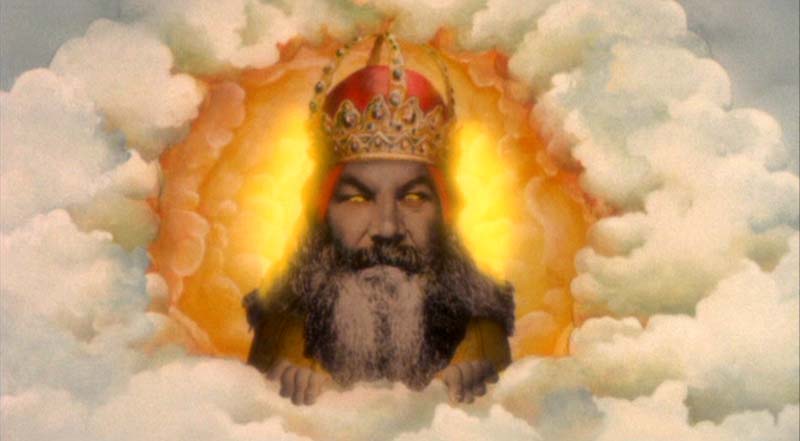
Angry God (courtesy of Monty Python)

In this week’s Torah portion, Korach ben Yitzhar foments a rebellion against Moses and Aaron. At the height of the mutiny, Korach gathers “the whole community against them at the entrance of the Tent of Meeting.” (Numbers 16:19)

The text continues:

Then the Presence of the Lord appeared to the whole community, and the Lord spoke to Moses and Aaron, saying, “Stand back from this community that I may annihilate them in an instant!” But they fell on their faces and said, “O God, Source of the breath of all flesh! When one man sins, will You be wrathful with the entire community?” (16:19-22)

I’m struck by a few things here:

This passage is, of course, powerfully reminiscent of another famous episode – namely, when Abraham challenges God not to engage in collateral damage during the destruction of Sodom and Gomorrah:

Will You sweep away the innocent along with the guilty? What if there should be fifty innocent within the city; will You then wipe out the place and not forgive it for the sake of the innocent fifty who are in it? Far be it for you to bring death upon the innocent as well as the guilty, so that the innocent and the guilty fare alike. Far be it from You! Shall not the Judge of all the earth deal justly?” (Genesis 18:22-25)

And this isn’t even the first time God angrily threatens to completely wipe out the Israelites themselves (see, for instance, Exodus 32:9-10 and Numbers 14: 11-12). Then, as well as here, Moses has to talk God off the ledge, so to speak.

It’s certainly more than a bit curious that God, who is elsewhere described as “a God compassionate and gracious; slow to anger, abounding in kindness and faithfulness” (Exodus 34:6) is repeatedly portrayed with an exceedingly explosive temper and serious anger management issues. It’s also a curious role reversal: a mere mortal is put in the position of reminding God to behave (and God repeatedly relents!)

What should we make of all this? As for me, as I’ve indicated before, I prefer not to read Biblical descriptions of God as theological treatises, but rather as powerful projections of our human struggles onto the image of God. (So you mean to tell me that you’re confused that God appears alternatively “compassionate” and “jealous,” “forgiving” and “vengeful?” Well, duh – God is only human after all…)

When I read these human – divine interactions, I can’t help but think about the ways in which we struggle internally with our ever-present penchant for all-consuming anger and destructiveness. Sometimes, à la Abraham, it means grappling with the inherent justice of our actions. Other times, as in the aftermath of the Golden Calf episode, our anger might back down in the face of our inner pride and shame.

I find this week’s struggle particularly powerful. By addressing God as “Source of breath of all flesh,” Moses and Aaron remind God/us that the very breath we breathe is a sacred essence that we share with all that lives. Whenever we allow ourselves to become consumed by our anger, our sense of this divine unity becomes fundamentally disrupted.  But if we understand that our breath is not ours to breathe alone, we experience our connection to the “Source of the Breath of All Flesh” – and we may well regain our physical/spiritual equilibrium.

(Could this be why breathing exercises have long been considered a time-honored method for dealing with anger management? Just sayin’…)

Alt-Country Theology: A Tutorial

Check out two very divergent takes on grief and loss by two wonderful alt-country singers: “The Duel,” by Allison Moorer and  “God is in the Roses” by Roseanne Cash (from her brilliant album “Black Cadillac,” one of my favorites.)

Both are profoundly personal reflections on God after the death of a loved one. I’m deeply moved by both, even if they express bereavement with radically different emotions and points of view.

I’d love to hear reactions.

“The Duel”
by Allison Moorer

In this cemetery mist
Stands a newborn atheist
Even if you do exist
You’re far from almighty
Flesh and blood’s a sissy fist
Death’s a gold glove pugilist
And everyday it’s hit or miss
That’s what I believe

I stared at my polished shoes
In front of your wooden pews
Prayed and prayed don’t let me lose
What my heart adores
Are miracles old-fashioned news
No healing hands were ever used
Faithfulness was my excuse
Tell me what was yours

I don’t know how many rounds
Are left in me ‘til I stay down
And there’s no telling where I’m bound
But one thing I’m sure of
The king of kings has lost his crown
It’s buried here in marble town
In the god forsaken ground
With my only love

“God is in the Roses”
by Rosanne Cash

God is in the roses
The petals and the thorns
Storms out on the oceans
The souls who will be born
And every drop of rain that falls
Falls for those who mourn
God is in the roses and the thorns

The sun is on the cemetery
Leaves are on the stones
There never was a place on earth
That felt so much like home
We’re falling like the velvet petals
We’re bleeding and we’re torn
But God is in the roses and the thorns

I love you like a brother
A father and a son
It may not last forever and ever
But it never will be done
My whole world fits inside the moment
I saw you be reborn
God is in the roses
And that day was filled with roses
God is in the roses and the thorns

On Sticks and Stones

From this week’s Torah portion, Shelach Lecha:

Once, when the Israelites were in the wilderness, they came upon a man gathering wood on the sabbath day. Those who found him, as he was gathering wood brought him before Moses, Aaron and the whole community. He was placed in custody, for it had not been speculated what should be done to him. Then the Lord said to Moses, “The man shall be put to death: the whole community shall pelt him with stones outside the camp.” So the whole community took him outside the camp and stoned him to death – as the Eternal had commanded Moses. (Numbers 15:32-36)

Yeah, this is a tough one.

So here’s my take: it isn’t God who hands down the death sentence upon this poor guy at all.

How can I say this? I say this because I believe the Torah to be a document written wholly by human authors – many different authors over a very long period of time. And as a composite document primarily concerned with God’s role in history and human society, it reflects many different voices that run a spectrum from our loftiest spiritual/ethical yearnings to our darkest and basest human impulses.

For those who are aghast that God could command such a heinous punishment for such a mild offense, here is the only answer I know to offer: this ain’t God. This is a description of an act of collective religious zealotry attributed to God by the Biblical author. A classic example of mob mentality in action.

Having said that, it’s not as if we don’t learn important lessons from this episode.  I’m struck by a few things in particular:

I’m struck that the community isn’t all that sure what to do with the wood-gatherer after they capture him. It is notable that God had not previously specified gathering sticks as a Shabbat prohibition. Perhaps they were concerned that his actions fell into a grey area – that he was gathering sticks with the intention of kindling a fire (which is explicitly prohibited by Torah.)  In any case, this is certainly a moment of collective legal confusion for the Israelite community.

I’m also struck that this episode follows upon God’s pronouncement that as punishment for its faithlessness, this generation of Israelites will not be allowed to enter the land of Israel (“your carcasses will drop in this wilderness, while your children roam in the wilderness for forty years…” 14:32-33.) In other words, the stick-gathering incident occurs during a desperate and terrifying moment for the Israelite people.

And I’m also struck that while the question is brought before “Moses, Aaron and the whole community,” it is God who renders the final verdict.  In my reading of this passage, however it is not God handing down the heinous sentence – God is merely a literary “stand-in” for a fearful and confused people who have resorted to mob behavior for unacceptable (if perhaps understandable) reasons.

While this episode has nothing to teach us about Shabbat observance, it still teaches us plenty about the dynamics of collective fear – and the cruelty with which we too often inflict our fear upon others…

…and maybe, just maybe, it is also a lesson about the ways we too often project our fear and cruelty onto God.

Do Atheists Belong in the Interfaith Tent?

Really interesting piece in Religion Dispatches by Christopher Stedman, Humanist Chaplain at Harvard University, who argues for the inclusion of atheists in the Interfaith Movement:

To atheists concerned about being seen as “just another faith” and worried that interfaith isn’t an avenue for substantive discourse: I encourage you to give it a shot anyway, and be vocal about where you stand. I cannot begin to recount all of the times interfaith work has opened up a space for robust conversations on problematic religious practices and beliefs—in fact, it has been a hallmark of my experience working in the interfaith movement. All the more, it has allowed me to engage religious people about atheist identity and eradicate significant misconceptions about what atheism is and what it isn’t…

In my experience, interfaith work doesn’t require that people check their convictions at the door—it invites people to try to understand and humanize the other. It’s a worthy goal, and if the only thing keeping some atheists from participating is a semantic disagreement with the word “faith,” I think that is a missed opportunity.