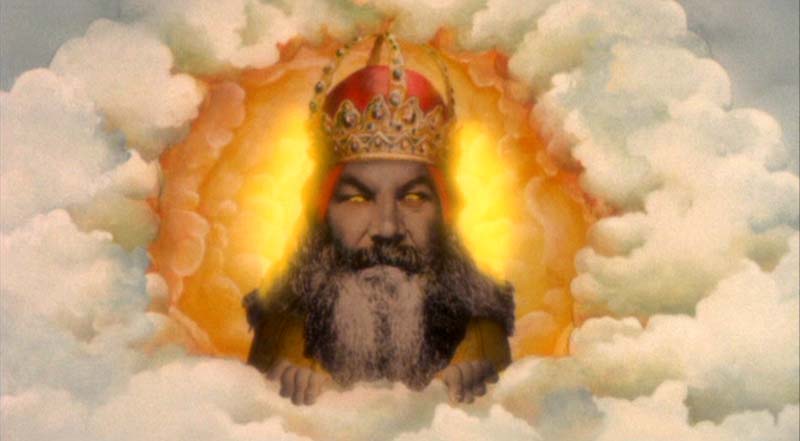
God Has Anger Management Issues

Angry God (courtesy of Monty Python)

In this week’s Torah portion, Korach ben Yitzhar foments a rebellion against Moses and Aaron. At the height of the mutiny, Korach gathers “the whole community against them at the entrance of the Tent of Meeting.” (Numbers 16:19)

The text continues:

Then the Presence of the Lord appeared to the whole community, and the Lord spoke to Moses and Aaron, saying, “Stand back from this community that I may annihilate them in an instant!” But they fell on their faces and said, “O God, Source of the breath of all flesh! When one man sins, will You be wrathful with the entire community?” (16:19-22)

I’m struck by a few things here:

This passage is, of course, powerfully reminiscent of another famous episode – namely, when Abraham challenges God not to engage in collateral damage during the destruction of Sodom and Gomorrah:

Will You sweep away the innocent along with the guilty? What if there should be fifty innocent within the city; will You then wipe out the place and not forgive it for the sake of the innocent fifty who are in it? Far be it for you to bring death upon the innocent as well as the guilty, so that the innocent and the guilty fare alike. Far be it from You! Shall not the Judge of all the earth deal justly?” (Genesis 18:22-25)

And this isn’t even the first time God angrily threatens to completely wipe out the Israelites themselves (see, for instance, Exodus 32:9-10 and Numbers 14: 11-12). Then, as well as here, Moses has to talk God off the ledge, so to speak.

It’s certainly more than a bit curious that God, who is elsewhere described as “a God compassionate and gracious; slow to anger, abounding in kindness and faithfulness” (Exodus 34:6) is repeatedly portrayed with an exceedingly explosive temper and serious anger management issues. It’s also a curious role reversal: a mere mortal is put in the position of reminding God to behave (and God repeatedly relents!)

What should we make of all this? As for me, as I’ve indicated before, I prefer not to read Biblical descriptions of God as theological treatises, but rather as powerful projections of our human struggles onto the image of God. (So you mean to tell me that you’re confused that God appears alternatively “compassionate” and “jealous,” “forgiving” and “vengeful?” Well, duh – God is only human after all…)

When I read these human – divine interactions, I can’t help but think about the ways in which we struggle internally with our ever-present penchant for all-consuming anger and destructiveness. Sometimes, à la Abraham, it means grappling with the inherent justice of our actions. Other times, as in the aftermath of the Golden Calf episode, our anger might back down in the face of our inner pride and shame.

I find this week’s struggle particularly powerful. By addressing God as “Source of breath of all flesh,” Moses and Aaron remind God/us that the very breath we breathe is a sacred essence that we share with all that lives. Whenever we allow ourselves to become consumed by our anger, our sense of this divine unity becomes fundamentally disrupted.  But if we understand that our breath is not ours to breathe alone, we experience our connection to the “Source of the Breath of All Flesh” – and we may well regain our physical/spiritual equilibrium.

(Could this be why breathing exercises have long been considered a time-honored method for dealing with anger management? Just sayin’…)

Alt-Country Theology: A Tutorial

Check out two very divergent takes on grief and loss by two wonderful alt-country singers: “The Duel,” by Allison Moorer and  “God is in the Roses” by Roseanne Cash (from her brilliant album “Black Cadillac,” one of my favorites.)

Both are profoundly personal reflections on God after the death of a loved one. I’m deeply moved by both, even if they express bereavement with radically different emotions and points of view.

I’d love to hear reactions.

“The Duel”
by Allison Moorer

In this cemetery mist
Stands a newborn atheist
Even if you do exist
You’re far from almighty
Flesh and blood’s a sissy fist
Death’s a gold glove pugilist
And everyday it’s hit or miss
That’s what I believe

I stared at my polished shoes
In front of your wooden pews
Prayed and prayed don’t let me lose
What my heart adores
Are miracles old-fashioned news
No healing hands were ever used
Faithfulness was my excuse
Tell me what was yours

I don’t know how many rounds
Are left in me ‘til I stay down
And there’s no telling where I’m bound
But one thing I’m sure of
The king of kings has lost his crown
It’s buried here in marble town
In the god forsaken ground
With my only love

“God is in the Roses”
by Rosanne Cash

God is in the roses
The petals and the thorns
Storms out on the oceans
The souls who will be born
And every drop of rain that falls
Falls for those who mourn
God is in the roses and the thorns

The sun is on the cemetery
Leaves are on the stones
There never was a place on earth
That felt so much like home
We’re falling like the velvet petals
We’re bleeding and we’re torn
But God is in the roses and the thorns

I love you like a brother
A father and a son
It may not last forever and ever
But it never will be done
My whole world fits inside the moment
I saw you be reborn
God is in the roses
And that day was filled with roses
God is in the roses and the thorns

On Sticks and Stones

From this week’s Torah portion, Shelach Lecha:

Once, when the Israelites were in the wilderness, they came upon a man gathering wood on the sabbath day. Those who found him, as he was gathering wood brought him before Moses, Aaron and the whole community. He was placed in custody, for it had not been speculated what should be done to him. Then the Lord said to Moses, “The man shall be put to death: the whole community shall pelt him with stones outside the camp.” So the whole community took him outside the camp and stoned him to death – as the Eternal had commanded Moses. (Numbers 15:32-36)

Yeah, this is a tough one.

So here’s my take: it isn’t God who hands down the death sentence upon this poor guy at all.

How can I say this? I say this because I believe the Torah to be a document written wholly by human authors – many different authors over a very long period of time. And as a composite document primarily concerned with God’s role in history and human society, it reflects many different voices that run a spectrum from our loftiest spiritual/ethical yearnings to our darkest and basest human impulses.

For those who are aghast that God could command such a heinous punishment for such a mild offense, here is the only answer I know to offer: this ain’t God. This is a description of an act of collective religious zealotry attributed to God by the Biblical author. A classic example of mob mentality in action.

Having said that, it’s not as if we don’t learn important lessons from this episode.  I’m struck by a few things in particular:

I’m struck that the community isn’t all that sure what to do with the wood-gatherer after they capture him. It is notable that God had not previously specified gathering sticks as a Shabbat prohibition. Perhaps they were concerned that his actions fell into a grey area – that he was gathering sticks with the intention of kindling a fire (which is explicitly prohibited by Torah.)  In any case, this is certainly a moment of collective legal confusion for the Israelite community.

I’m also struck that this episode follows upon God’s pronouncement that as punishment for its faithlessness, this generation of Israelites will not be allowed to enter the land of Israel (“your carcasses will drop in this wilderness, while your children roam in the wilderness for forty years…” 14:32-33.) In other words, the stick-gathering incident occurs during a desperate and terrifying moment for the Israelite people.

And I’m also struck that while the question is brought before “Moses, Aaron and the whole community,” it is God who renders the final verdict.  In my reading of this passage, however it is not God handing down the heinous sentence – God is merely a literary “stand-in” for a fearful and confused people who have resorted to mob behavior for unacceptable (if perhaps understandable) reasons.

While this episode has nothing to teach us about Shabbat observance, it still teaches us plenty about the dynamics of collective fear – and the cruelty with which we too often inflict our fear upon others…

…and maybe, just maybe, it is also a lesson about the ways we too often project our fear and cruelty onto God.

Do Atheists Belong in the Interfaith Tent?

Really interesting piece in Religion Dispatches by Christopher Stedman, Humanist Chaplain at Harvard University, who argues for the inclusion of atheists in the Interfaith Movement:

To atheists concerned about being seen as “just another faith” and worried that interfaith isn’t an avenue for substantive discourse: I encourage you to give it a shot anyway, and be vocal about where you stand. I cannot begin to recount all of the times interfaith work has opened up a space for robust conversations on problematic religious practices and beliefs—in fact, it has been a hallmark of my experience working in the interfaith movement. All the more, it has allowed me to engage religious people about atheist identity and eradicate significant misconceptions about what atheism is and what it isn’t…

In my experience, interfaith work doesn’t require that people check their convictions at the door—it invites people to try to understand and humanize the other. It’s a worthy goal, and if the only thing keeping some atheists from participating is a semantic disagreement with the word “faith,” I think that is a missed opportunity.

Race and Infection

In this week’s Torah portion, Parashat Beha’alotecha, Aaron and Miriam unexpectedly disparage their brother Moses:

When they were in Hatzerot, Miriam and Aaron spoke against Moses because of the Cushite woman he had married: “He married a Cushite woman!” (Numbers 12:1)

Moses’ siblings’ slur is confusing on a number of levels. In the first place, it’s not quite clear who this “Cushite woman” actually is. Cush is commonly understood to refer to ancient Ethiopia (in Genesis 10:6 we read that the Cushites descended from Ham, the son of Noah.) However, Moses’ wife Zipporah is a Midianite, not a Cushite.

Commentators have handled this discrepancy in different ways. Some suggest that Zipporah and the Cushite woman are the same person. (Pointing out that Habbakuk 3:7 refers to a Midianite tribe called Cushan). Other Biblical scholars posit that the reference to the Cushite wife is a fragment of a larger literary tradition that has since gone the way of history.

These theories are interesting as far as they go, but in the end they fail to address the most troubling dimension to this episode: namely, the patently racist nature of Miriam and Aaron’s words.

Indeed, whatever else might be going on in this cryptic Biblical narrative, it might be, at least in part, an anti-racist polemic. After her unabashedly xenophobic exclamation “He married a Cushite woman!” it is more than a bit ironic that Miriam is stricken with tzara’at – a skin affliction that manifests itself with “snow-white scales.” (12:10) In a sense, God seems to be saying to Miriam: “You like white so much, I’ll show you white!”

Classical Jewish commentators famously understand tzara’at to be a physical manifestation of the sin of lashon harah – negative speech, or gossip. For myself, I’ve always found this interpretation to be less compelling as theology (i.e. illness is a result of divine punishment) than as a metaphor for the virulent nature of hate speech. I would prefer to say it this way: Miriam’s malady is not literally caused by her words; rather, her infectious tzara’at mirrors the inner properties of her racist words themselves.

Alas, we know this to be all too true: hate speech can be fatally infectious. Left unchecked, racism almost invariably spreads virally through society. Centuries after these Biblical words were written, hateful words continue to mutate into racist attitudes and actions in new and frightening ways.

Life at the Margins: Shavuot and the Queer Experience

A lovely Shavuot drash by my friend and colleague Rabbi Josh Lesser, of Congregation Bet Haverim in Atlanta – a Reconstructionist community founded by gays and lesbians:

What queer person cannot relate to Naomi’s fate at one time or another? Feeling lonely, without family, without support and without a clear picture of the future – surely many of us remember a time like that. If we are lucky like Naomi, that reality changes. When she encourages her daughters-in-law to return to a more certain future with security and promise one daughter-in-law, Ruth, stays and pledges an oath of fidelity inextricably binding her life to Naomi’s forever, giving us one of the Torah’s most poignant examples of a family of choice. Her pledge is so complete that some people question if there was more than a mother-daughter bond, but rather that of a life partner. Indeed many people, lesbians and straight folk alike, use Ruth’s pledge as part of their life-long commitment to each other. The text does not answer what their relationship is, but the question itself is important and allows us to wonder. To me, the even more powerful message is that through this pledge, the future changes, a future that will eventually lead to the messianic age.

This transformation is the most queer part of the text. It is this pledge of mutuality and shared destiny in the face of the unknown that enables what is clearly a path of despair and hopelessness to be transformed so powerfully that it produces the seed of the messianic line. Through a series of events, some even say through God’s hand, Ruth meets Boaz, a kinsman of Naomi. He admires her dedication to Naomi and offers them support and comfort. Eventually, Boaz decides to join their family of choice from which an offspring emerges beginning the Davidic messianic line. Here we see that God can be powerfully known and experienced through a relationship. If that is not a revelation as profound as Torah, I do not know what is. It is often through selfless giving that God is known as powerfully as if the earth was shaking and thundering. Even more revealing for queer folks is that this relationship occurred in the margins. The central elements of this story take place in Moab, a questionable place at the time, and in the fields – a place of danger and transition. The central players are likewise marginal: widows, older people and strangers. And yet, here in the margins, godliness manifests. Ruth is a testament to everyone that God’s presence resides in those places society shuns or pities.

Facing God, Facing One Another

This week’s Torah portion, Parashat Naso, contains what is possibly the most well-known extant blessing in Biblical tradition: the Birkat Cohenim or “Priestly Blessing:”

May ADONAI bless and protect you. May ADONAI shine (God’s) face upon you show favor to you. May ADONAI turn (God’s) face to you and grant you peace. (Numbers 6:23-26)

One of the most notable aspects of this blessing is its metaphorical use of “God’s face.” The final two blessings utilize this image in two different ways: in the second blessing, the “light” of God’s countenance bestows acceptance or grace (in Hebrew, chen); in the third and final blessing, the “turning” of God’s face expresses Shalom – peace, wholeness, fulfillment.

The metaphor of God’s face is used throughout the Bible, often to convey the powerful and immediate experience of the Divine Presence. In the closing verses of the Torah, for instance, Moses’ unique relationship with God underscored when we read that “God singled him out face to face” (Deuteronomy 34:10). On the other hand, the concept of hester panim (the “hiding of God’s face”) is often invoked to convey divine anger and punishment (see, for instance, Deuteronomy 31:18).

As poetic as these images may be, I personally struggle with their overly supernatural/anthropomorphic usages. I’m much more drawn to poignantly humanistic way “God’s face” is invoked during the reconciliation of the estranged twin brothers Jacob and Esau.

Upon their reunion, Jacob says to his older brother:

Please, if you would do me this favor, accept from me this gift; for to see your face is like seeing the face of God… (Genesis 33:10)

This use of the metaphor suggests that Godliness is particularly manifest in the act of conflict resolution – when former enemies find the wherewithal to “turn their faces” to one another. In this regard, we might well view the Birkat Cohenim not merely as a blessing of well-being but as a spiritual imperative to all who receive it.

When does God’s face shine upon us or turn to greet us? When we turn our faces to one another in acceptance and peace.

On Choosing Films of Faith

Can’t wait to see Terence Malick’s “The Tree of Life” (above) which looks pretty awesome and is being hailed by many as a film with powerfully existential/spiritual themes.

In anticipation of “Tree’s” release, I recently surfed over to Arts & Faith’s “Top 100 Films.” Though I consider myself something of a film nerd, I was pretty humbled to discover I haven’t seen the majority of films on the list (and haven’t even heard of a fair amount of them either.)

Check it out yourself and see if you agree with the rankings. As for me, I have no argument with “The Passion of Joan of Arc” as #1, but what on earth is “Make Way for Tomorrow“- a minor 1937 comedy directed by Leo McCarey, of “Duck Soup” fame – doing at #6? And I’m sorry, as much as I love Orson Welles’ “Touch of Evil,” I’m not sure I’d call it a spiritually themed movie.

And as for Jewish films, was “Fiddler on the Roof really the best they could do?  Granted there aren’t that many “Jewish films of faith” to choose from, but off the top of my head, I’d nominate “The Quarrel,” “Enemies: A Love Story,” or the Coen Bros’ “A Serious Man for starters…