Life at the Margins: Shavuot and the Queer Experience

A lovely Shavuot drash by my friend and colleague Rabbi Josh Lesser, of Congregation Bet Haverim in Atlanta – a Reconstructionist community founded by gays and lesbians:

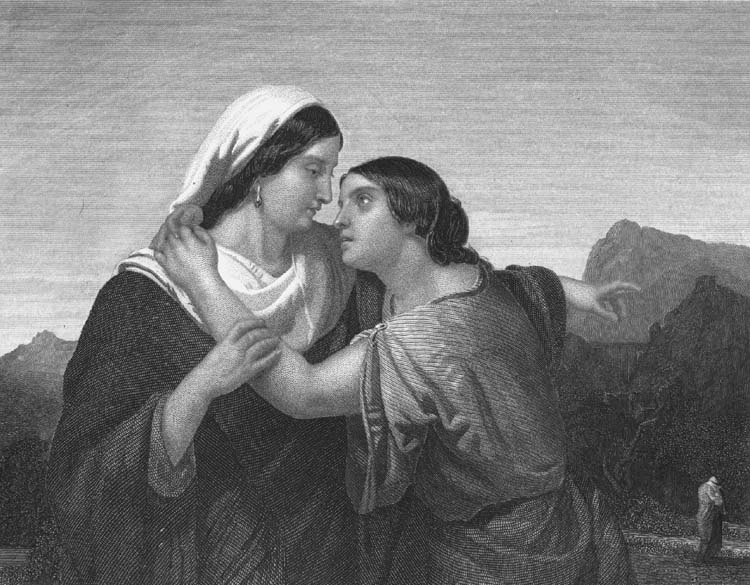
What queer person cannot relate to Naomi’s fate at one time or another? Feeling lonely, without family, without support and without a clear picture of the future – surely many of us remember a time like that. If we are lucky like Naomi, that reality changes. When she encourages her daughters-in-law to return to a more certain future with security and promise one daughter-in-law, Ruth, stays and pledges an oath of fidelity inextricably binding her life to Naomi’s forever, giving us one of the Torah’s most poignant examples of a family of choice. Her pledge is so complete that some people question if there was more than a mother-daughter bond, but rather that of a life partner. Indeed many people, lesbians and straight folk alike, use Ruth’s pledge as part of their life-long commitment to each other. The text does not answer what their relationship is, but the question itself is important and allows us to wonder. To me, the even more powerful message is that through this pledge, the future changes, a future that will eventually lead to the messianic age.

This transformation is the most queer part of the text. It is this pledge of mutuality and shared destiny in the face of the unknown that enables what is clearly a path of despair and hopelessness to be transformed so powerfully that it produces the seed of the messianic line. Through a series of events, some even say through God’s hand, Ruth meets Boaz, a kinsman of Naomi. He admires her dedication to Naomi and offers them support and comfort. Eventually, Boaz decides to join their family of choice from which an offspring emerges beginning the Davidic messianic line. Here we see that God can be powerfully known and experienced through a relationship. If that is not a revelation as profound as Torah, I do not know what is. It is often through selfless giving that God is known as powerfully as if the earth was shaking and thundering. Even more revealing for queer folks is that this relationship occurred in the margins. The central elements of this story take place in Moab, a questionable place at the time, and in the fields – a place of danger and transition. The central players are likewise marginal: widows, older people and strangers. And yet, here in the margins, godliness manifests. Ruth is a testament to everyone that God’s presence resides in those places society shuns or pities.
Counting the Omer in Funkytown

Today is the thirty-seventh day of the Omer, which according to Jewish mystical symbolism corresponds to the Divine attribute of Gevurah (“Strength”) within Yesod (“Foundation.”)

Looking for spiritually alternative ways to count the Omer? Click above to watch/listen to the great John Zorn Ensemble perform “Gevruah,” then below for Zorn’s “Yesod,” as performed by the Crakow Klezmer Band.

As you listen, read this rendering of Psalm 24 by Stephen Mitchell:

The earth belongs to the Lord
     and everything on it is his.
For he founded it in empty space
     and breathed his own life-breath into it,
filling it with manifold creatures,
     each one precious in his sight.

Who is fit to hold power
     and worthy to act in God’s place?
Those with a passion for the truth,
     who are horrified by injustice,
who act with mercy to the poor
     and take up the cause of the helpless,
who have let go of selfish concerns
    and see whole earth as sacred,
refusing to exploit her creatures
     or to foul her waters and her lands.
Their strength is in their compassion;
     God’s light shines through their hearts.
Their children’s children will bless them,
    and the work of their hands will endure.

And/or this excerpt from James Dickey’s poem, “The Strength of the Fields:”

Dear Lord of all the fields
                                             what am I going to do?
                                      Street-lights, blue-force and frail
As the homes of men, tell me how to do it
    To withdraw    how to penetrate and find the source
      Of the power you always had
                                            light as a moth, and rising
       With the level and moonlit expansion
    Of the fields around, and the sleep of hoping men.
       You?    I?    What difference is there?    We can all be saved
       By a secret blooming. Now as I walk
The night    and you walk with me    we know simplicity
  Is close to the source that sleeping men
       Search for in their home-deep beds.
      We know that the sun is away    we know that the sun can be conquered
   By moths, in blue home-town air.
          The stars splinter, pointed and wild. The dead lie under
The pastures.    They look on and help.    Tell me, freight-train,
                            When there is no one else
   To hear. Tell me in a voice the sea
         Would have, if it had not a better one: as it lifts,
          Hundreds of miles away, its fumbling, deep-structured roar
               Like the profound, unstoppable craving
            Of nations for their wish.
                                                      Hunger, time and the moon:
         The moon lying on the brain
                                                    as on the excited sea    as on
          The strength of fields. Lord, let me shake
         With purpose.    Wild hope can always spring
         From tended strength.    Everything is in that.
            That and nothing but kindness.    More kindness, dear Lord
Of the renewing green.    That is where it all has to start:
         With the simplest things. More kindness will do nothing less
             Than save every sleeping one
             And night-walking one
         Of us.
                  My life belongs to the world. I will do what I can.

Yizkor and the Rhythms of Remembrance

As we do every year, JRC just observed a Yizkor (“Memorial”) service to mark the end of the Pesach holiday. This particular year, I introduced our memorial prayers by saying that mourning itself is something of an open-ended journey – and one that rarely unfolds in a predictable manner. I also pointed out that more recent research in the psychology of grief tends to reject the linear “Stages of Grief” approach made famous by Elizabeth Kübler-Ross.

From a recent piece in The New Yorker:

Though Kübler-Ross captured the range of emotions that mourners experience, new research suggests that grief and mourning don’t follow a checklist; they’re complicated and untidy processes, less like a progression of stages and more like an ongoing process—sometimes one that never fully ends.

I do believe that the notion of grief as an “ongoing process” is at the heart of the Yizkor memorial observance. It often feels to me that there is a powerful rhythm to the practice of saying memorial prayers during major four festivals of the year (Yom Kippur, Sukkot, Pesach and Shavuot). Since each festival has its own unique spiritual themes, the process of ongoing Yizkor observance drives home the truth that grief is a cyclical – rather than linear – experience

Here is my own take on how this process resonates through the Jewish holiday season:

Yizkor of Yom Kippur – “Dwelling in the In-Between:” the Day of Atonement is, if you will, the spiritually rawest time of the Jewish calendar. It is the time in which we acknoweldge our mortality and look into the coming year with a potent emotional mix of awe and trepidation. The tenor of Yizkor for Yom Kippur thus resonates with the pain and uncertainty that inevitably comes with grief. In the juncture between a year past and a year yet to come, we allow ourselves to dwell in that “in-between place” between the past we know and the future we have yet to experience.

Yizkor of Sukkot/Shemini Atzeret – “Preparing for Winter:” Immediately after the harvest festival of Sukkot comes the observance of Shemini Atzeret, which marks the beginning of the rainy season in Israel. Our Yizkor prayers are recited during our preparation for winter – the season in which we construct the necessary protection and defenses for these cold, dark months. Yizkor for Sukkot/Shemini Atzeret honors these defenses – as well as the spiritual work we know we must do in order to make it through the long nights ahead.

Yizkor of Pesach – “Inevitability of Life Renewed:” On Passover we begin to see the green shoots of new life sprouting up from the previously hard, fallow earth. The natural world around us testifies to the inevitability of liberation – and we come to understand that this rebirth is indeed woven into the very fabric of creation. So too, with our own lives as we walk the path of the mourner: the Yizkor of Pesach comes to remind us that there is life after grief as surely as Spring follows Winter.

Yizkor of Shavuot – “Celebrating the Fruits of our Labor:” On Shavuot, we bring in the harvest. As Spring moves in to full bloom, we now begin to reap what we’ve sown. We now affirm that all of the hard work (and bereavement is nothing if not hard work) does indeed pay off if we do it in a spirit of openness and love. On this Yizkor, we celebrate the fruits of our labors – and rededicate ourselves to the journey ahead.

It’s a shame that the observance of Yizkor tends to be falling off among liberal Jews. I truly believe there is great spiritual resonance in these rituals – which cycle outward over the seasons and throughout the years. Even for those who are not traditionally observant Jews, there is real meaning to be found in these rhythms of remembrance.

The next Yizkor will occur in several weeks, on Shavuot. (May you reap a bountiful harvest…)

Countdown to Sinai: An Omer Calendar Sampler

Calendar for counting the Omer, Amsterdam, Netherlands ca. 1794

I recently received a lovely new Omer calendar, “A Journey Through the Wilderness,” in the mail from my dear friend Rabbi Yael Levy of Reconstructionist congregation Mishkan Shalom. I’ve practiced the ritual of Counting the Omer off and on over the years; her immensely creative new effort has inspired me to take it on again with renewed intention this year.

I’ll let Rabbi Yael’s own words describe this unique spiritual discipline:

The counting of the Omer is the 49-day period between Passover and Shavuot, when it is the practice to stand every night and, in the midst of opening and closing prayers, count each day.

This counting began as an agricultural ritual. Our ancestors would pray for an abundant spring harvest by waving a sheaf, an Omer, of barley toward the night sky. Over time, this agricultural rite was replaced by liturgy and the counting became the way to mark the Israelites’ journey from bondage in Egypt to revelation at Mt. Sinai.

For the Jewish mystics of the 16th and 17th centuries, the Counting of the Omer became a time of spiritual exploration and cleansing, a way for us to prepare our souls to receive the divine guidance that comes to us each year on Shavuot.

Counting the Omer is a 49-day mindfulness practice aimed at helping us pay attention to the movement of our lives, to notice the subtle shifts, the big changes, the yearnings, the strivings, the disappointments, the hopes and the fears. It is an opportunity for deep introspection, a call to notice our inclinations, our default responses, our reactions to shifting emotions and circumstances…

The mystical tradition teaches that these 49 days between Passover and Shavuot are divided into seven-week periods, with each week containing a specific spiritual quality. The qualities are by guided by seven of the ten sefirot, the Divine emanations through which, the mystics believed, God reveals Godself in the world.

Today, by the way, is the fifth day of the Omer, which corresponds to the daily sefirah of Hod within the weekly sefirah of Chesed. Rabbi Yael renders this formula “Presence Within Love.”  As she instructs us, this is the day in which we contemplate upon:

Being where we are rather than where we think we should be or where we wish we could be.

Cultivating the capacity to be patient with ourselves and others, knowing that we are all doing the best we can in each moment.

If you are interested in delving deeper into this practice, here are some other Omer resources you might check out:

– Rabbi Rami Shapiro’s  Omer Journal, which includes the eclectic wisdom of spiritual teachers such as The Ba’al Shem Tov, Franz Kafka, Rilke and Lao Tzu;

– Rabbi Jill Hammer’s “Omer Calendar of Biblical Women,” which thematically connects one Biblical woman to each day of the Omer;

A calendar created by Pauline Frankenberg of the University of Manchester Centre for Jewish Studies, who painted illustrations depicting specific plants mentioned in the Bible for each day of the Omer;

– And finally, a must-have for every Omer enthusiast:  the now-legendary Simpsons Omer counter known as “The Homer Calendar.”

Safe travels to Sinai…