Dayenu as Irony? That’s Quite Enough!

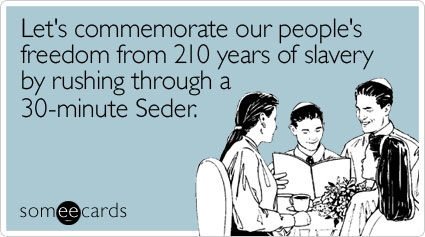
Just in time for Passover, here’s British author Howard Jacobson’s fascinating take on Dayenu as the ultimate sarcastic Jewish joke:

Superfluous though we insist each of God’s favors and blessings to us was, the truth is we would have been in serious trouble without any of them. For where would have been the use of His leading us to the Red Sea had He not parted it; or our wandering for 40 years in the wilderness, had He not provided us with Manna? We say the one would have sufficed without the other, but in fact it would not. Thus the song is as much a rehearsal of complaints we might have voiced and might voice yet, as it is a hymn of praise.

Built into this magnificent song of gratitude, therefore, is the fact of our colossal ingratitude. Nothing is enough for us. Not because we are vainglorious or greedy, but because our appetite for intellectual dissatisfaction, like our apprehension of disaster, knows no bounds. Call it the ravenousness of reasoning—the rabbinic “on the one hand this, on the other hand that.” Call it our love of striking bargains. Call it hyperbole. Call it what you like, it is the bedrock of Jewish comedy. As it is the bedrock of our faith.

The Jewish joke is above all a strategy for survival. It looks, of necessity, to the future. It anticipates a woe before that woe is visited upon us. It gets in first with the criticism and the cruelty. If anybody is going to knock us around it won’t be the Cossacks, it will be ourselves. So that while a Jewish joke appears to be the perfecting of self-denigration, it is actually the opposite. It is the fruit of a perpetual vigilance and in the process demonstrates an intelligence that is, because it has to be, unremitting.

If there were such a thing as a perfect Jewish joke—and who is to say that the Dayenu is not it?—it would never finish. Ours is a religion of suspense. We wait and wait, for a God who cannot show Himself and a Messiah we would rather never came. We await an end, as we await a punch line, to a narrative that has no end. And just when we thought it was all over, it begins again. What are the last words of the Dayenu? “It would have sufficed us …” But by now our ear demands another clause, another gift, another setback for God to overcome. There is no final thank-you because there is no final sufficiency.

If this whets your appetite, check out the entire piece in Tablet Magazine.

instruction manual for the high priest


in order for the offering to ascend
properly it must stay on the altar all
night make sure the fire is kept
burning until morning when the offering
has been reduced to ash when the
remaining cinders have danced out of the
fire flying up like slaves set free at
last take the dying embers and go outside
far outside the camp to a place you have never
been before and dump them in a heap still
smoking still burning with desire
when you return wash yourself thoroughly then
place more wood on the altar you
must not let the fire go out do
not let the fire
go out

(Leviticus 6:1-6)

pillar of smoke, pillar of fire

say goodbye to the mountain
goodbye to the warm and
trembling earth gather it all up the
tent poles the utensils the
hangings the posts the pots the pans the
tent pegs tomorrow we leave for the
wilderness don’t plan don’t think don’t
hesitate just dive deep and burn up your deepest
most unblemished yearning the pillars of
smoke and fire billowing forth from the altar will
guide you throughout all
your journeys

(Exodus 39:39-40, 40:36-38)

an offering to the most high

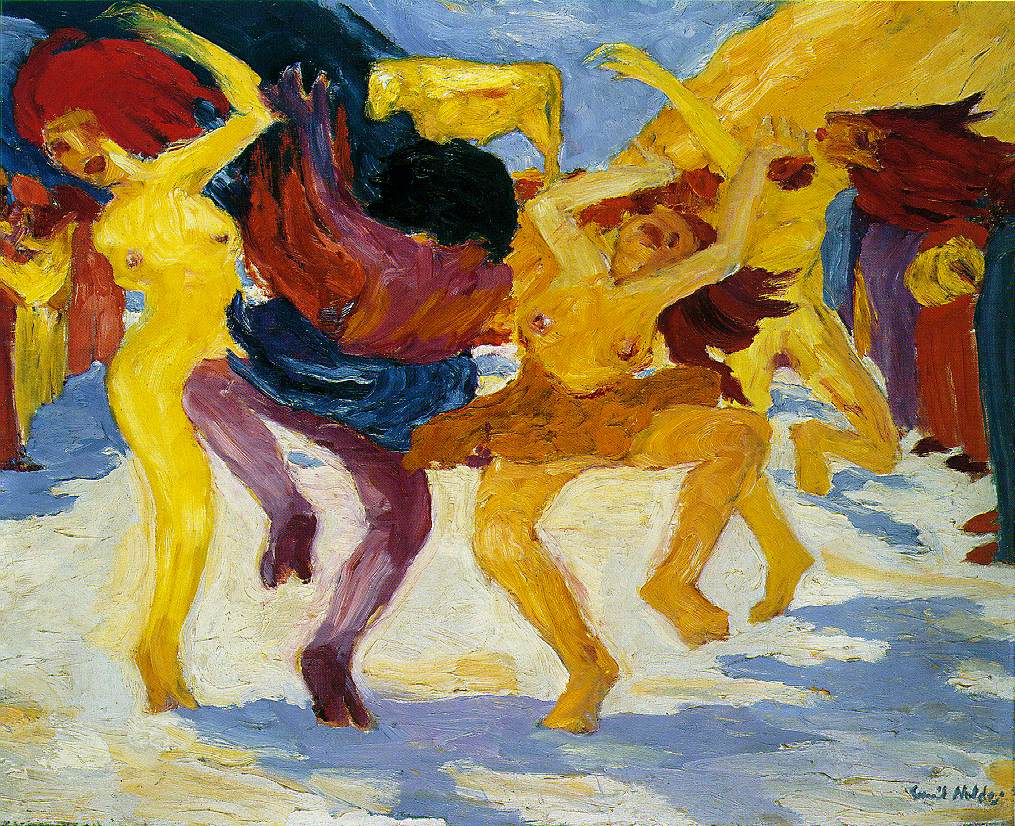
Emil Nolde, “Dance Around the Golden Calf”

while the two men sat on the mountaintop
chiseling commandments in stone
the people poured out their fears
gleaming like pure gold from the altar
of their surrendered desires
they cried tomorrow shall be a festival
to the most high
then offering up their wildest hopes
their desperate dreams dancing they
shouted out hallels until at last
they came into the heart of their liberation
and faced the blinding truth of their commitment
when moses came down and saw
the people wheeling and whirling round
like sacred scrolls unfurling
he shattered the dusty tablets
at the foot of the mountain
and joined in the dance.

(Exodus 32:1-5)

a kingdom of priests


now if you walk in my ways if you
honor in the divine image planted deep
within you will see you are all treasured all
holy yes you are a kingdom of priests look
inside see how you are adorned in
sacral vestments of gold and blue and purple
and crimson look deep inside see how your hearts shine
forth like precious stones close your eyes see how your
minds eye gleams like pure gold look
deeper still there you will encounter the holiest
of holies there i will meet with you there
i will speak with you

(Exodus 28:4-5, 17, 36)

Jewish Law/Muslim Law = Laws for Life, Not “Hegemonic Political Force”

Highly recommended (and extremely important): this recent Moment Magazine article by legal scholar Marshall Breger, “Why Jews Can’t Criticize Sharia Law.”

An excerpt:

While clearly some Muslims do view sharia as a hegemonic political force, the vast majority of Muslims, especially those living in the West, view sharia no differently from the way Jews view the halachic system: as an overarching guide to ordering one’s life. Muslim jurists have always drawn on sharia to mandate that fellow Muslims obey the laws of the land in matters that sharia does not prohibit. In numerous instances (see Koran 5:11), Muslims are told to “honor their contracts” and so to honor the “social contract” represented by the law of the land. The Fiqh Council of North America, the leading interpreter of Islamic law in the United States, ruled as recently as September 2011 that “there is no inherent conflict between the normative values of Islam and the U.S. Constitution and the Bill of Rights.”

i slightly rearrange the laws of exodus

when my angel goes before you and brings you to the
amorites the hittites the canaanites the hivites the
jebusites i will not drive them out before you lest
the land become desolate do not annihilate them
nor tear them down nor smash their pillars for
if you mistreat them i will heed their outcry as
soon as they cry out to me and my anger
shall blaze forth
against you

works for me

(Exodus 22:20-23, 23:23-24)

Fun Facts for Valentine’s Day

Some fun fast facts for Valentine’s Day. Did you know that:

The feast of St. Valentine was established by Pope Gelasius I in 496.  Some say that Valentine’s feast day is celebrated in February because the church wanted to Christianize an ancient Roman pagan festival called Lupercalia, which centered around fertility and purification, and also took place in February.

Valentine’s feast day has been celebrated as a lovers’ holiday and a day of romance since the 14th century, when the date was thought to be the beginning of the mating season for birds.

Many claim the closest Jewish equivalent of Valentine’s Day was Tu B’Av (“the fifteenth of Av”):

Tu B’Av, the 15th Day of Av, is both an ancient and modern holiday. Originally a post-biblical day of joy, it served as a matchmaking day for unmarried women in the second Temple period (before the fall of Jerusalem in 70 C.E.). Tu B’Av was almost unnoticed in the Jewish calendar for many centuries but it has been rejuvenated in recent decades, especially in the modern state of Israel. In its modern incarnation it is gradually becoming a Hebrew-Jewish Day of Love, slightly resembling Valentine’s Day in English-speaking countries.

There is no way to know exactly how early Tu B’Av began. The first mention of this date is in the Mishnah (compiled and edited in the end of the second century), where Rabban Shimon ben Gamliel is quoted saying, “There were no better (i.e. happier) days for the people of Israel than the Fifteenth of Av and Yom Kippur, since on these days the daughters of Israel/Jerusalem go out dressed in white and dance in the vineyards. What were they saying: Young man, consider whom you choose (to be your wife)?”(Ta’anit, Chapter 4).

Happy Lovin’…

A Single Tree is Really a Whole Forest: Zen Wisdom for Tu B’shvat

In honor of Tu B’shvat – the Jewish New Year for the Trees – I offer you these lovely tidbits from “Trees and Spirituality: An Exploration” by Dr. Nalini Nadkarni, who teaches Environmental Studies at Evergreen State College.

Happy Tu B’shvat – and may your roots discover hidden spheres of growth in the coming year!

Enlightenment
Trees link us to enlightenment. Their ubiquitous shape and form, their persistence through time, and their “rootedness” in the soil, remind us of the connection between earth and the heavens.

Buddha sat mediating under a Bodhi tree. When dawn came, the sun brought enlightenment to him.

As if to reinforce this universality, we see tree forms everywhere – in rivers, caves, blood vessels, lungs – and in the form of Zen Buddhism itself. Historically, temples follow lineages, like family trees. Each temple was brought into a hierarchy, with branch temples under main temples and each level responsible for the one beneath.

Breathing
Like other living beings, trees “breathe.” Through photosynthesis, they help supply the most basic of needs of humans – giving us clean air to breathe. This connection to breathing links trees to meditation and reflection.

The Hebrew word for breath – neshama – is the same as the word for soul. Our spiritual life force comes by way of air and respiration.

Silence
In the services I attended this fall, the most powerful moments were the moments of silence – the time between speaking and hymns. Buddhist silence, samantha – stopping, calming, concentrating – is very important. It is the same as the stillness I see when I look up at a tree on a windless summer day. Trees are rooted in the ground and make no sound. They epitomize samantha.

Emptiness
…In Zen practice, you do not strive to delete all thoughts. Rather, you discover the emptiness that is present within the form of thoughts, experiences and realities.

Most researchers who study the forest focus on the trees and animals – the forms. In contrast, Dr. Roman Dial studies the emptiness within the forest. He uses a laser to get distances to branches and leaves, making images of their “negative space.” These are stunning in their beauty and also in their significance. How does a bird negotiate through space? How does a pollen grain move? Or a termite queen, or a particle or pollutant?

Oneness
According to Buddhist thinking, the idea of a separate “self” is an illusion. There is no external individual being apart from interaction with the world. Although we each have a separate set of perceptions and sensations, the idea that there is a fixed “self” is a false inference.

Trees remind us of this because a tree is a modular being. Most animals, including humans, develop and grow as a single entity. In contrast, the seed of a tree germinates into a root and a shoot, which in turn differentiates into branches, with buds that become the next generation of leaves, flowers, and fruits, and so on. Along the way, genetic material can undergo mutations and changes.

Thus a mature tree contains thousand of separate branch systems, each a separate “lineage,” a separate genetic entity. Fruit growers know that certain branches produce much better fruit. They can graft the best branch and start another tree that will produce to that type. So a single tree is really a whole forest. There are many in one.

Time
Trees help humans tell time; they spell the seasons. Nothing tells us about the passing of time more clearly than autumn colors or the tender green of emerging buds.

Forests teach us about the dynamism of nature – the need to accept change even if it seems to be destructive. When I go out to my forest plots and see a fallen tree – a tree I have climbed a hundred times, taken data from, named – I have to remind myself that this is the nature of the forest. Seedlings will grow in the light created by the fallen giant.

Hidden Worlds
Trees manifest hidden spheres. Their roots are underground and out of sight yet provide support for the tree and serve as the gathering apparatus for water and nutrients. The belowground world sustains the aboveground parts. Tree roots can symbolize that which we hide from ourselves and others – our troubles, failings, ill-health. To be truthful – full of troth – like a tree, we must recognize that these hidden parts are an important part of us, not something to discount, just as soil-covered roots of a tree are essential to its being.

(From Northwest Dharma News, October/November 2002, pp. 10, 13)

Purim Came Early This Year

Oh wow…

Anthea Butler, writing in Religion Dispataches:

While most Christians were having regular Sunday services, over at Eddie Long’s New Birth Church in Lithonia, Ga, Ralph Messer, who is part of the Hebrew Roots movement, was crowning Eddie Long King in an elaborate ceremony that included wrapping Long in a Torah Scroll purported to be found at Auschwitz and Birkenau.

In case you’re unable or unwilling to watch: the video shows Messer giving Long the Torah scroll declaring that he is the first man to look upon the scroll after 3000 years. Long is “wrapped in the scroll” and prayed over. Messer asks Long to take a seat, and declares that God gave Long a position of power and authority. He is given the constitution of God as a king (6:49), the Torah, and then, Messer has four men representing the four corners of the earth, (7:04) pick the chair up. Messer then declares that Eddie Long is raised up from a commoner to a King, replete with music, cheers, and a poorly executed blessing in Hebrew. If it weren’t so offensive to Christian and Jewish sensibilities (and so utterly in error in terms of tradition, as Wil Gafney points out at HuffPo)  it would be laughable.

Last word goes to Peter Manseau, also from Religion Dispatches:

When Messer broke into Hebrew song as Long was paraded aloft in a chair, carrying the Torah and draped with a prayer shawl, it was like watching a summer stock revival of Yentl performed by a cast that had never met any actual Jews.

I have no more to add…