Fun Facts for Valentine’s Day

Some fun fast facts for Valentine’s Day. Did you know that:

The feast of St. Valentine was established by Pope Gelasius I in 496.  Some say that Valentine’s feast day is celebrated in February because the church wanted to Christianize an ancient Roman pagan festival called Lupercalia, which centered around fertility and purification, and also took place in February.

Valentine’s feast day has been celebrated as a lovers’ holiday and a day of romance since the 14th century, when the date was thought to be the beginning of the mating season for birds.

Many claim the closest Jewish equivalent of Valentine’s Day was Tu B’Av (“the fifteenth of Av”):

Tu B’Av, the 15th Day of Av, is both an ancient and modern holiday. Originally a post-biblical day of joy, it served as a matchmaking day for unmarried women in the second Temple period (before the fall of Jerusalem in 70 C.E.). Tu B’Av was almost unnoticed in the Jewish calendar for many centuries but it has been rejuvenated in recent decades, especially in the modern state of Israel. In its modern incarnation it is gradually becoming a Hebrew-Jewish Day of Love, slightly resembling Valentine’s Day in English-speaking countries.

There is no way to know exactly how early Tu B’Av began. The first mention of this date is in the Mishnah (compiled and edited in the end of the second century), where Rabban Shimon ben Gamliel is quoted saying, “There were no better (i.e. happier) days for the people of Israel than the Fifteenth of Av and Yom Kippur, since on these days the daughters of Israel/Jerusalem go out dressed in white and dance in the vineyards. What were they saying: Young man, consider whom you choose (to be your wife)?”(Ta’anit, Chapter 4).

Happy Lovin’…

A Single Tree is Really a Whole Forest: Zen Wisdom for Tu B’shvat

In honor of Tu B’shvat – the Jewish New Year for the Trees – I offer you these lovely tidbits from “Trees and Spirituality: An Exploration” by Dr. Nalini Nadkarni, who teaches Environmental Studies at Evergreen State College.

Happy Tu B’shvat – and may your roots discover hidden spheres of growth in the coming year!

Enlightenment
Trees link us to enlightenment. Their ubiquitous shape and form, their persistence through time, and their “rootedness” in the soil, remind us of the connection between earth and the heavens.

Buddha sat mediating under a Bodhi tree. When dawn came, the sun brought enlightenment to him.

As if to reinforce this universality, we see tree forms everywhere – in rivers, caves, blood vessels, lungs – and in the form of Zen Buddhism itself. Historically, temples follow lineages, like family trees. Each temple was brought into a hierarchy, with branch temples under main temples and each level responsible for the one beneath.

Breathing
Like other living beings, trees “breathe.” Through photosynthesis, they help supply the most basic of needs of humans – giving us clean air to breathe. This connection to breathing links trees to meditation and reflection.

The Hebrew word for breath – neshama – is the same as the word for soul. Our spiritual life force comes by way of air and respiration.

Silence
In the services I attended this fall, the most powerful moments were the moments of silence – the time between speaking and hymns. Buddhist silence, samantha – stopping, calming, concentrating – is very important. It is the same as the stillness I see when I look up at a tree on a windless summer day. Trees are rooted in the ground and make no sound. They epitomize samantha.

Emptiness
…In Zen practice, you do not strive to delete all thoughts. Rather, you discover the emptiness that is present within the form of thoughts, experiences and realities.

Most researchers who study the forest focus on the trees and animals – the forms. In contrast, Dr. Roman Dial studies the emptiness within the forest. He uses a laser to get distances to branches and leaves, making images of their “negative space.” These are stunning in their beauty and also in their significance. How does a bird negotiate through space? How does a pollen grain move? Or a termite queen, or a particle or pollutant?

Oneness
According to Buddhist thinking, the idea of a separate “self” is an illusion. There is no external individual being apart from interaction with the world. Although we each have a separate set of perceptions and sensations, the idea that there is a fixed “self” is a false inference.

Trees remind us of this because a tree is a modular being. Most animals, including humans, develop and grow as a single entity. In contrast, the seed of a tree germinates into a root and a shoot, which in turn differentiates into branches, with buds that become the next generation of leaves, flowers, and fruits, and so on. Along the way, genetic material can undergo mutations and changes.

Thus a mature tree contains thousand of separate branch systems, each a separate “lineage,” a separate genetic entity. Fruit growers know that certain branches produce much better fruit. They can graft the best branch and start another tree that will produce to that type. So a single tree is really a whole forest. There are many in one.

Time
Trees help humans tell time; they spell the seasons. Nothing tells us about the passing of time more clearly than autumn colors or the tender green of emerging buds.

Forests teach us about the dynamism of nature – the need to accept change even if it seems to be destructive. When I go out to my forest plots and see a fallen tree – a tree I have climbed a hundred times, taken data from, named – I have to remind myself that this is the nature of the forest. Seedlings will grow in the light created by the fallen giant.

Hidden Worlds
Trees manifest hidden spheres. Their roots are underground and out of sight yet provide support for the tree and serve as the gathering apparatus for water and nutrients. The belowground world sustains the aboveground parts. Tree roots can symbolize that which we hide from ourselves and others – our troubles, failings, ill-health. To be truthful – full of troth – like a tree, we must recognize that these hidden parts are an important part of us, not something to discount, just as soil-covered roots of a tree are essential to its being.

(From Northwest Dharma News, October/November 2002, pp. 10, 13)

Purim Came Early This Year

Oh wow…

Anthea Butler, writing in Religion Dispataches:

While most Christians were having regular Sunday services, over at Eddie Long’s New Birth Church in Lithonia, Ga, Ralph Messer, who is part of the Hebrew Roots movement, was crowning Eddie Long King in an elaborate ceremony that included wrapping Long in a Torah Scroll purported to be found at Auschwitz and Birkenau.

In case you’re unable or unwilling to watch: the video shows Messer giving Long the Torah scroll declaring that he is the first man to look upon the scroll after 3000 years. Long is “wrapped in the scroll” and prayed over. Messer asks Long to take a seat, and declares that God gave Long a position of power and authority. He is given the constitution of God as a king (6:49), the Torah, and then, Messer has four men representing the four corners of the earth, (7:04) pick the chair up. Messer then declares that Eddie Long is raised up from a commoner to a King, replete with music, cheers, and a poorly executed blessing in Hebrew. If it weren’t so offensive to Christian and Jewish sensibilities (and so utterly in error in terms of tradition, as Wil Gafney points out at HuffPo)  it would be laughable.

Last word goes to Peter Manseau, also from Religion Dispatches:

When Messer broke into Hebrew song as Long was paraded aloft in a chair, carrying the Torah and draped with a prayer shawl, it was like watching a summer stock revival of Yentl performed by a cast that had never met any actual Jews.

I have no more to add…

Who You Gonna Serve Now

"The Delivery of Israel Pharaoh and his Hosts Overwhelmed in the Red Sea" by Francis Danby (1825)

then he sang this song to moses and the
israelites singing i am your god and you will
enshrine me the god of your fathers you must
exalt me i am the man of war who went up
against the false gods of egypt and cracked them like so
much dry straw the one who hurls chariots and soldiers
into the sea like small stones the one who will cast terror and
dread on the inhabitants of canaan for their sins i’m
your champion your protector your god my commands will
soon be revealed to you follow them lest i strike
you down as i’ve destroyed all the others maybe
someday you’ll be ready to serve the master
the one who’s greater yes even greater
than me

(Exodus 15: 1-5, 15-16, 26)

A New Reconstructionist Dialogue on Chosenness

Check out this lovely dialogue on the meaning of “chosenness” in Zeek Magazine by two eloquent Reconstructionist rabbinical colleagues: Rabbis Deborah Waxman and Nancy Fuchs-Kreimer.

Ever since Reconstructionist Judaism’s founder Rabbi Mordecai Kaplan famously (some believe infamously) dispensed of the Chosen People idea from his conception of Jewish theology, its meaning has been a point of lively debate in our movement.  Here’s a taste of how that conversation is playing out now in the 21st century:

Rabbi Waxman:

Rejecting chosenness is an explicit embrace of a modern discourse pointing toward universal truths; it is an articulation of harmonious and consistent principles out of competing voices. Rejecting chosenness is about getting down to the hard work of being one of the many peoples of the world, jostling with one another on the path toward the divine, rather than holding ourselves separate and nurturing a belief in God-given superiority. As postmoderns, we may have the capacity to hold multiple and conflicting values. When it comes to chosenness, I would argue that that we should not indulge in this capacity; by moving beyond chosenness, we make a deliberate statement about our highest values.

Rabbi Fuchs-Kreimer:

(No) matter what I choose in my own religious practice, I cannot simply ignore a core piece of our tradition. The idea of chosenness has not gone away. As a Jew, I still own it, even if I do not speak of it in my prayers. In the interfaith encounter, I have to resist the temptation to claim only the parts of Judaism I love. If I skip over the Jewish ideas I find objectionable or, more often, if I explain that they belong to someone else – “the mistaken Jews” – I am acting in a way that is both arrogant and untrue to my own pluralistic commitments. My dialogue principles require that I learn to understand the beliefs of my co-religionists even when I do not share them.

Passover Observance Then and Now


and when your children ask you what
do you mean by this rite tell them
in the beginning we offered late night sacrifices
and supplications while our god meted out
punishments against the gods of egypt later
we hid behind behind doorjambs swelled with
dread murmuring pour out your wrath on
those who seek our blood and destroy the nations who know
not your name but now we observe by bursting the
gates of fear wide open proclaiming let all who’ve been
broken gather each another’s scattered
shattered pieces let all who seek liberation
come to the table let all who are hungry
come and eat

(Exodus 12:12, 26-27)

Moses Hearing Voices

god said to moses i established my
covenant with abraham isaac and jacob to
give them the land of canaan this sounds to me like the
voice of imperial ambition god said to moses i will harden
pharoah’s heart that i may multiply my signs and marvels in
the land of egypt this sounds to me like
the voice of insecurity god said to moses i
have spared you in order that my fame may resound
throughout the world this sounds to me like the voice of
hubris god said to moses lift your rod and
i will strike the nile with the blood of our babies let
it overrun the land of egypt until it rots this sounds to
me like the voice of pain god said to moses i have heard the
cries of the israelites i will free them from their
bondage and set them free to serve an even greater
good this sounds to me like the
voice of god

(Exodus 6:2-6, 7:19, 9:16)

A Shiva for the New Millenium?

In his recent NY Times piece, “Mourning in the Age of Facebook,” author/journalist Bruce Feiler suggests what many have long observed: in the post-modern world, we’re witnessing traditional religious mourning practices adapted in ever new and interesting ways.

In his article, Feiler describes at length something he calls “Secular Shiva” – a phenomenon in which he claims he has participated more than once. Here’s his description of this newly adapted Jewish mourning ritual:

Don’t wait for the griever to plan: … With a traditional shiva, the burden falls on the family to open their home to sometimes hundreds of people. If you are considering a “secular shiva,” insist on doing the planning yourself, from finding a location, to notifying guests, to ordering food.

By invitation only. Traditional shivas are open houses; they’re communitywide events in which friends, neighbors and colleagues can stop by uninvited. Our events were more restricted, with the guest of honor suggesting fewer than a dozen invitees. “An old-fashioned shiva would have felt foreign to me,” said my friend Karen, who lost her mother last summer. “I’m more private. If it was twice the size, I wouldn’t have felt comfortable.”

“Would you like to share a few stories?” At the event we held for Karen, she opted to speak about her mom. For 45 emotional minutes, she talked about her mother’s sunny disposition, her courtship, her parenting style. It was like watching a vintage movie.

“I liked speaking about my mom,” she told me. “One, I hadn’t had time to fully grieve because I was so focused on my dad. And two, there was something each of you could come away with about who my mom was in the world.”

At a later event, a Catholic friend who had lost her brother chose not to speak about him. She felt too fragile, she later explained. Instead she handed out CDs with a photo montage of her brother’s life. “I think if I hadn’t had the pictures, I would have felt the need to talk about him.”

The comfort of crowds. While I came away from these events convinced we had hit on a new tool for our circle of friends, I was quickly warned not to assume our model was universal.

“Introverts need to grieve, too,” Ms. Andrews said. “For some, a gathering of this kind might be a particular kind of torture.”

My two cents:

Despite his term “Secular Shiva,” I warmly welcome these sorts of changes Feiler describes here. As someone who routinely attends and helps organize shivas on a fairly regular basis, I’ve noticed that many mourners are already incorporating many of the elements Feiler describes.

I don’t think it’s necessarily a religious/secular issue – I think many who consider themselves religious in a more liberal sense feel fully comfortable adapting the tradition shiva rites to fit their needs. In fact, virtually none of my congregants observe the full, traditional seven-day shiva, the prospect of which invariably feels overwhelming – and in some ways even counterproductive.

As I often tell mourners who ask if it’s “OK” to change or adapt some of these rituals: Absolutely. At the end of the day, I believe the purpose of religious ritual is to serve our needs and not the other way around.

God Felt the Burning

Proxima Centuri - the nearest star to the sun

the israelites cried out to god a
shout hurtling into space shining like a
star that would not die like a luminous
ball of plasma burning on and
on like the thermonuclear fusion of endless boundless
hydrogen that can never be exhausted
light emanating from proxima centauri takes
4.22 light years to be seen on earth it took 400 years
for oppression to transform into
liberation burning white hot but
never consumed

(Exodus 2:23-24)

Monday Morning Quarterbacking on Faith

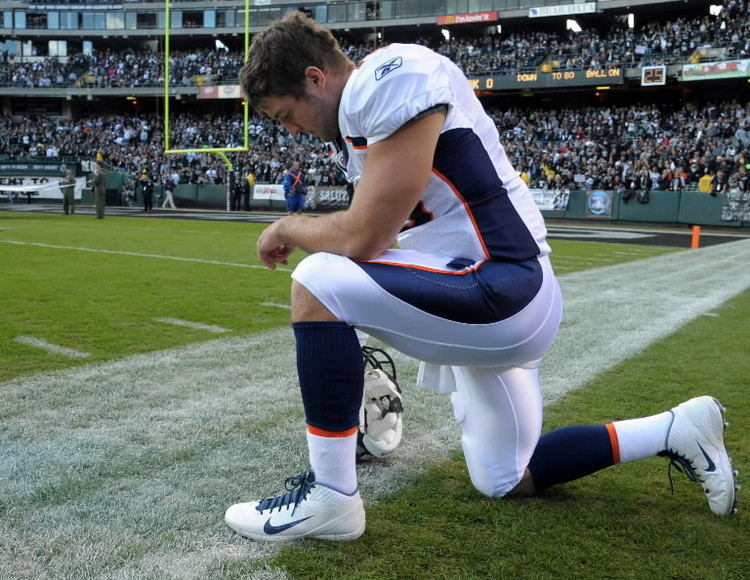
I got into a brief theological kerfuffle in the Twittersphere today over Denver Broncos quarterback Tim Tebow, who openly (and for some, obnoxiously) expresses his evangelical Christian faith. After Tebow led the Broncos to a dramatic overtime win over the Pittsburgh Steelers (and as usual, thanked God for the victory), a friend of mine tweeted:

according to Tebow, God has nothing better to do than help him win football games. Tebow is the Santorum of quarterbacks.

To which I responded:

From a Denver fan pov, it’s not that God wants Tebow to win, it’s that this belief gives him the edge he needs to win games.

My friend then tweeted me back:

Tebow sure doesn’t see it that way. His ostentatious proselytizing is loathsome and contemptible.

My response:

Loathsome and contemptible? I dunno, I don’t agree at all with his politics or theology, but those are pretty strong words. I’d sooner use those words to describe roethlisberger’s behavior than tebow’s…

(Ben Roethlisberger, btw, is the quarterback for the Pittsburgh Steelers, who was accused of sexual assault in 2008 and 2010).

My friend responded to this:

if the best you can say about Tebow is that he’s a better man than Roethlesrapist you’ve made my point for me.

Me:

never said that was the best I could say about him. Only applied ur words more appropriately.

Another Tweeter chimed in:

I can’t fault Tebow for his faith, but I can fault Roethlisberger for his actions.

Further thoughts welcome…