Unknown's avatar

About Rabbi Brant Rosen

I'm a rabbi, blogger, and activist with a special interest in Israel/Palestine justice work.

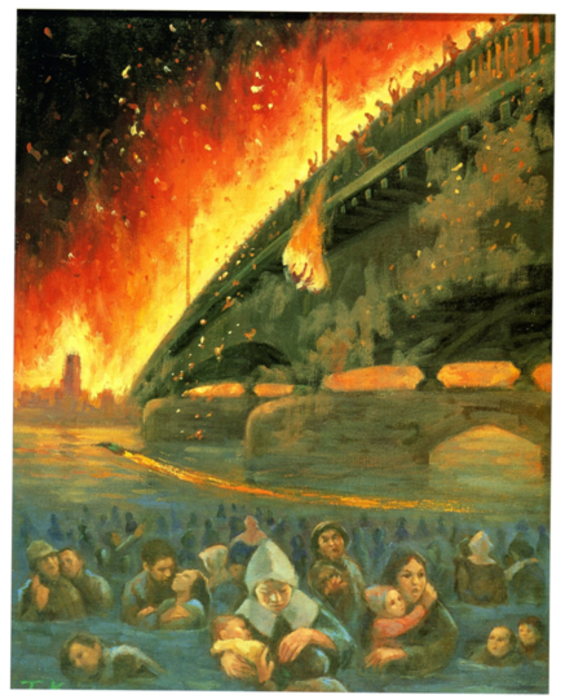
Abraham Argues With God, Tokyo 1945

"The Flames of Kototoi Bridge—Memories of Losing my Family," painting by Kano Teruo

will you sweep away innocent with
the guilty what if there are
fifty innocent within the city will
you wipe out the place far be it from
you to do such a thing to
bring death upon the innocent the
M-69s which released 100-foot streams of fire upon
detonating sent flames rampaging through
densely packed wooden homes superheated air created
a wind that sucked victims into the flames and
fed the twisting infernos asphalt
boiled in the 1,800-degree heat with much of
the fighting-age male population at the war
front women children and the elderly
struggled in vain to battle the flames or flee
like other survivors nihei who escaped the fire with her
family intact said the bombing showed that war is
never justifiable those images in my mind can never
be erased she said i can see myself there the
flames all around me and i’m running for my
life shall not the judge of all the
earth act justly?

(Genesis 18:23-25 with AP article, “1945 Tokyo Firebombing Left Legacy of Terror, Pain” by Joseph Coleman)

Avram and Sarai Take Their Leave

you must
go leave your
native land leave behind all
you know all you
have all you
love shatter everything your
father holds sacred your mother’s desperate
hopes and dreams crazy shards
flying up pinwheeling like sparks spinning
off a sacrificial
fire go beyond leap into the
dark to a place you do
not know and maybe never will
offer up your trust like
a writhing bleating newborn
lamb on the altar yes go and seek
your blessing find your place among the families
of the earth you really think you’re so
different what makes you so
special

(Genesis 12:1-3)

Der Golem Wishes You a Happy Halloween

In honor of Halloween, dig this: “Golem” – an unfinished film by the great Czech director Jiří Barta, best known for his stop-motion animated films made during the communist era. After the fall of the Soviet Union Barta was unable to find funding for his work – alas, he was only able to complete a short version of “Golem” in 1996.

Still, what remains of the film is brilliantly animated, foreboding, and deliciously creepy.  As you can see, it follows the terrifying visions of an old rabbi as he walks through the alleys of present day and old world Prague, which eventually morphs into stone like the mythical golem.

JRC members mark your calendars: I’ll be teaching a three session class on the legend of the Golem in January…

God Considers the Generation of Noah

the earth is filled with it
creation’s choking on it
gone horribly wrong the bloodshed so much
blood soaking the earth polluting
the earth cries out to me shrieking
just shrieking out to me i can’t stand it
any more i can’t think i can’t
hear myself think what was i
thinking what was i thinking
i am undone i
will undo tear down the
firmament open up the
floodgates let the waters
let chaos rain down
let the dark waters below
rise up let’s undo creation
wash the earth clean what have i
done
seemed like such a good
good idea at the
time

(Genesis 6:11-12, 7:11)

In the Beginning, In God’s Image

Rabbi Akiva says: “‘Love your fellow as yourself'” (Leviticus 19:18), is the greatest principle of the Torah.

Ben Azzai says, “‘When God created man, He made him in the image of God’ (Genesis 5:1) is the greatest principle in the Torah. You should not say: Because I have been dishonored, let my fellow be dishonored along with me…”

Rabbi Tanhuma explained: “If you do so, know whom you are dishonoring – ‘He made him in the image of God.'”

Midrash Genesis Rabbah 24

In this classic Midrash, Rabbis Akiba and Ben Azzai are doing what Talmudic rabbis do best: playing a lively game of spiritual oneupsmanship. The question at hand: what is the central value of Torah?  According to Akiba it is the famous verse from Leviticus, “Love your neighbor as yourself.” Ben Azzai counters with the insight from this week’s Torah portion: humanity was created in God’s image.

Rabbi Tanhuma’s final statement reinforces the weakness of Akiba’s claim: though it is certainly praiseworthy to love your fellow as yourself, this might imply that you only need to treat your fellow as well (or as badly) as you yourself are treated. Ben Azzai points out that if we truly understand that all people are made in the image of God, we must accept that any time we shame, insult or abuse another, we do the same to God.

In a sense, Ben Azzai raises the moral stakes of the equation. As the saying (often misattributed to Dostoevsky) goes: “where there is no God, all is permitted.” This drives home the radical imperative made clear in the very first chapter of Genesis: if all people are made in the divine image, all people are of infinite worth; all people are deserving of dignity, respect and fair treatment.

The Torah thus begins with this foundational principle, which has both interpersonal/ethical as well as global/moral implications. As we start Torah anew yet again, we return to its central question: how can we find the wherewithal to treat everyone we meet as a fellow child of God? How can we, as Americans, as Jews, as global citizens find dignity and respect for all who dwell on earth?

A Poem for Sukkot: The Season Turns

It’s the festival of Sukkot – the holiday in which we (among many other things) liturgically chant from the book of Ecclesiastes.

Here, below, is my new version of the most famous part: Chapter 3, verses 1 through 8.

Kohelet 3:1-8

an eon turns to a millisecond
swing from here and to
there keeping rhythm here
to there and back again we are
born and we
die we plant and
we uproot
we kill we heal we
destroy and we rebuild again
we cry out and we laugh to the high
high heavens we throw stones and
gather them up once
more we embrace and we turn
away cast our eyes down
down to the ground we seek and
we lose we may yet find we
hoard and we purge we tear
and then sew back up we hold our tongues
and we scream like rain
we’re spitting in the wind
such a fine fine line between
love and hate and war
and peace enjoy it
while you can

Locking Our Children Away: Sermon for Erev Yom Kippur 5772

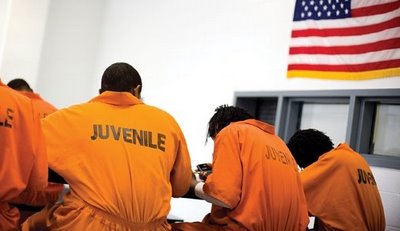
Cedric Cal was born to a single mother, in a family that lived below the poverty line on Chicago’s West Side. His father had left the family, married another woman and had very little to do with him. His mother Olivia worked constantly, doing her best to keep her family together. As the oldest of four, Cedric became the de facto father of the family and was entrusted with protecting his younger brother, who was legally blind.

Cedric’s family moved around a lot and he learned very early on how to make friends quickly. He liked sports, particularly baseball – and when his family lived on the West Side, he played sports in the local Park District. When they moved to the South Side, however, there were no Park District services available, so sports were not an option for him. Still, no matter where they moved, Olivia became very adept at finding ways of getting Cedric and and brothers into decent public schools. From 5th to 8th grade, he attended Alcott Elementary. Minding his younger brother, he took the public bus every day on a long trek from the West Side to Lincoln Park.

Cedric’s mother taught him how to fill out applications and interview for jobs, but there really weren’t any to be found. And those that were hiring certainly weren’t hiring African-American teenage boys. He was never really successful at finding a real job,  but when he was 14 he learned that he could make money dealing drugs. He knew that his mother would be beyond furious if she ever found out, so he made sure to keep his drug dealing and his growing gang activity secret from her. Cedric never, ever, brought his earnings into their home – his mother had made it clear that drug money was not welcome anywhere near her house. Even when he bought a car, he parked it far away from their home.

I met and spoke with Cedric two weeks ago at the Stateville Correctional Center in Joliet. He explained to me that as he continued to sell drugs, as he continued the gang life, little by little, he became “desensitized to the things my mother had taught me.” It was quite poignant and sweet to listen to Cedric speak about his mother. “My mother,” he said, “has a lovely spirit,” adding: “I was scared to death of my mother.” He told me of one instance in which Olivia confronted drug dealers on a street corner with a two by four in her hand. Cedric laughed and said that could scare even the toughest gang members in the neighborhood.

Continue reading

The Season of Our Service: Sermon for Erev Rosh Hashanah 5772

As my Torah study students will attest, the book of Deuteronomy can be pretty tough stuff. Deuteronomy, of course, is the final book of the Torah, and most of it is a monologue delivered by Moses to the Israelites before they cross into the Promised Land. As Moses is about to die, he engages in a kind of review lesson for the people, relating their history, describing their journey and reminding them of the laws they have agreed to as part of their covenant with God.

This last part – the theological emphasis on the covenant – is a major theme in Deuteronomy. Over and over, God tells the Israelites through Moses: “You’re about to enter the Land. Just follow my laws and you’ll be fine. But break them and you’ll be very, very, sorry.”

It’s really not to hard to discern these theological threats throughout Deuteronomy– in fact we read them over and over and over again. God tells the Israelites that a deal’s a deal – and they had better hold up their end or else. And of course the “or else” is spelled out repeatedly – often in gruesomely vivid detail.

Now, of all the laws contained in this covenant, there is one in particular that God seems particularly uptight about: that is, namely, the law against worshiping other gods. That’s not to say God isn’t concerned about laws such as murder, theft, providing for the poor, caring for the stranger… While these kinds of laws are certainly mentioned, the stakes always seem to be the highest when it comes to the commandment against idolatry – against serving gods of foreign nations.

Continue reading

A Song of Ascents for Rosh Hashanah

My new take on Psalm 126 – it feels just right for Rosh Hashanah.

Shanah Tovah U’Metukah – May you and may we all be blessed with a sweet and renewing New Year!

Psalm 126
My song of assent
I will return from this exile
wake up
from this bad dream
my crazy laughter’s busting out
I’m learning to sing
all over and over and over
again
only now do I know
you were there all along
coaxing me along to this
place of my return oh yes
you’ll bring me home
like water
roaring down dry river beds
I’ll be coming home
those who sowed with tears
will reap with joy
those who bury their pain deep
will soon gather
their bountiful harvest

Is Life a Choice?

From this week’s Torah portion, Nitzavim/Vayelech:

I call heaven and earth to witness against you this day: I have put before you life and death, blessing and curse. Choose life – if you and your offspring would live… (Deuteronomy 31:19)

What does it mean to “choose life?” After all, isn’t life-force a voluntary reflex?  In Genesis 2:7 we read that “(the Lord God) blew in his nostrils the breath of life, and man became a living being.”  We know from contemporary science that neurons from our brain send out electrical impulses that are carried by our nervous system to the rest of our body. Even while we sleep at night, our hearts continue to beat, circulating our blood which enable our bodies to function. In what way could life possibly be a “choice?”

While physical life is certainly involuntary, living the life of the spirit is a choice we make every day, every minute, every second of our lives.

For me, one of the most profound examples of this teaching can be found in the classic “Man’s Search for Meaning,” by Victor Frankl:

We who lived in concentration camps can remember the men who walked through the huts comforting others, giving away their last piece of bread. They may have been few in number, but they offer sufficient proof that everything can be taken from a man but one thing: the last of the human freedoms – to choose one’s attitude in any given set of circumstances, to choose one’s own way.