God Felt the Burning

Proxima Centuri - the nearest star to the sun

the israelites cried out to god a
shout hurtling into space shining like a
star that would not die like a luminous
ball of plasma burning on and
on like the thermonuclear fusion of endless boundless
hydrogen that can never be exhausted
light emanating from proxima centauri takes
4.22 light years to be seen on earth it took 400 years
for oppression to transform into
liberation burning white hot but
never consumed

(Exodus 2:23-24)

Isaac Digs a Well

so isaac departed from there and
encamped in the wadi of gerar where
he dug anew the wells
which had been dug in the days
of his father abraham digging
deep he’s clawing at the
dry dead earth those long
buried voices leaking out
gurgling up like hidden springs burst
open cast out that horrid slave woman and her son
now take your other son whom you love so very
very much and bind him up tight don’t
worry god will provide for the sacrifice my
boy so he named that well sitnah that means
pain his eyes so filled with his hot
tears he doesn’t notice at
first the ground growing softer and
sweeter who is this woman
walking in the field toward me
i am your god fear not for
i am with you i will bless you i
will keep you safe so isaac changed
the name of the well to rechovot that means
god had torn open his bindings and
gave his soul wide open space to
roam when he woke up his servants
came to him and told him about the well they
had dug and said to him we have
found water

(Genesis 26:18, 21, 32)

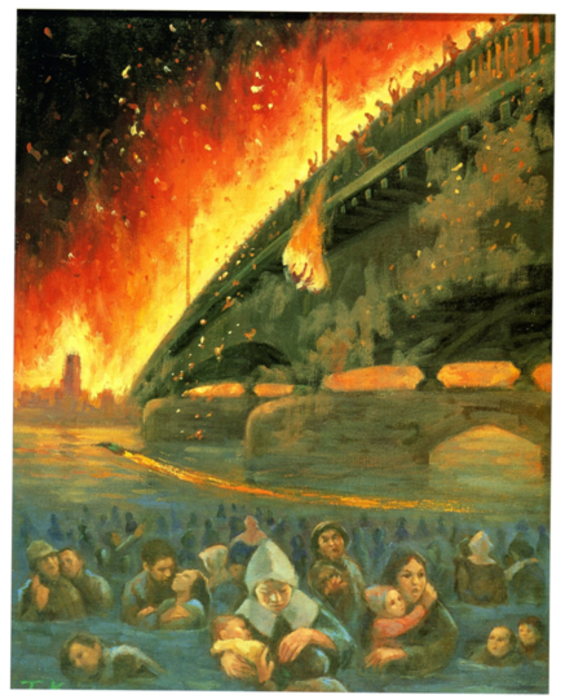
Abraham Argues With God, Tokyo 1945

"The Flames of Kototoi Bridge—Memories of Losing my Family," painting by Kano Teruo

will you sweep away innocent with
the guilty what if there are
fifty innocent within the city will
you wipe out the place far be it from
you to do such a thing to
bring death upon the innocent the
M-69s which released 100-foot streams of fire upon
detonating sent flames rampaging through
densely packed wooden homes superheated air created
a wind that sucked victims into the flames and
fed the twisting infernos asphalt
boiled in the 1,800-degree heat with much of
the fighting-age male population at the war
front women children and the elderly
struggled in vain to battle the flames or flee
like other survivors nihei who escaped the fire with her
family intact said the bombing showed that war is
never justifiable those images in my mind can never
be erased she said i can see myself there the
flames all around me and i’m running for my
life shall not the judge of all the
earth act justly?

(Genesis 18:23-25 with AP article, “1945 Tokyo Firebombing Left Legacy of Terror, Pain” by Joseph Coleman)

Avram and Sarai Take Their Leave

you must
go leave your
native land leave behind all
you know all you
have all you
love shatter everything your
father holds sacred your mother’s desperate
hopes and dreams crazy shards
flying up pinwheeling like sparks spinning
off a sacrificial
fire go beyond leap into the
dark to a place you do
not know and maybe never will
offer up your trust like
a writhing bleating newborn
lamb on the altar yes go and seek
your blessing find your place among the families
of the earth you really think you’re so
different what makes you so
special

(Genesis 12:1-3)

God Considers the Generation of Noah

the earth is filled with it
creation’s choking on it
gone horribly wrong the bloodshed so much
blood soaking the earth polluting
the earth cries out to me shrieking
just shrieking out to me i can’t stand it
any more i can’t think i can’t
hear myself think what was i
thinking what was i thinking
i am undone i
will undo tear down the
firmament open up the
floodgates let the waters
let chaos rain down
let the dark waters below
rise up let’s undo creation
wash the earth clean what have i
done
seemed like such a good
good idea at the
time

(Genesis 6:11-12, 7:11)

A Poem for Sukkot: The Season Turns

It’s the festival of Sukkot – the holiday in which we (among many other things) liturgically chant from the book of Ecclesiastes.

Here, below, is my new version of the most famous part: Chapter 3, verses 1 through 8.

Kohelet 3:1-8

an eon turns to a millisecond
swing from here and to
there keeping rhythm here
to there and back again we are
born and we
die we plant and
we uproot
we kill we heal we
destroy and we rebuild again
we cry out and we laugh to the high
high heavens we throw stones and
gather them up once
more we embrace and we turn
away cast our eyes down
down to the ground we seek and
we lose we may yet find we
hoard and we purge we tear
and then sew back up we hold our tongues
and we scream like rain
we’re spitting in the wind
such a fine fine line between
love and hate and war
and peace enjoy it
while you can

A Song of Ascents for Rosh Hashanah

My new take on Psalm 126 – it feels just right for Rosh Hashanah.

Shanah Tovah U’Metukah – May you and may we all be blessed with a sweet and renewing New Year!

Psalm 126
My song of assent
I will return from this exile
wake up
from this bad dream
my crazy laughter’s busting out
I’m learning to sing
all over and over and over
again
only now do I know
you were there all along
coaxing me along to this
place of my return oh yes
you’ll bring me home
like water
roaring down dry river beds
I’ll be coming home
those who sowed with tears
will reap with joy
those who bury their pain deep
will soon gather
their bountiful harvest

Is The Bible Destroying Creation?

From this week’s Torah portion, Parashat Shoftim:

When in your war against a city you have to besiege it a long time in order to capture it, you must not destroy (“bal tashchit”) its trees, wielding the ax against them. You may eat of them, but you must not cut them down. Are trees of the field human to withdraw before you in the city? Only trees that you know do not yield food may be destroyed.” (Deuteronomy 20:19-20)

It’s a tribute to the subversive creativity of Talmudic tradition that the Rabbis could take a text such as this – coming from a litany of Biblical laws concerning warfare – and transform it into Jewish tradition’s foundational environmental commandment.

Indeed, the sages of the Talmud would eventually apply the term bal tashchit (“do not destroy”) to apply to issues far transcending concern over fruit-bearing trees during wartime.  The concept “bal tashchit” eventually became a Jewish legal term referring to the destruction of natural resources on a wide scale, ranging from the wanton killing of animals (Talmud Hullin 7b) to the wasting of fuel (Talmud Shabbat 67b).

Since the Jewish imperative to care for the environment is Biblically based, it might come as a surprise to learn that many in the environmental movement blame Biblical tradition for promoting the exploitation of the earth’s natural resources.  I still remember well when Time Magazine promoted environmental concerns by choosing Earth as “Planet of the Year”  in 1989.  In its cover story, Time made the following pointed observation:

Humanity’s current predatory relationship with nature reflects a man-centered world view that has evolved over the ages. Almost every society has had its myths about the earth and its origins. The ancient Chinese depicted Chaos as an enormous egg whose parts separated into earth and sky, yin and yang. The Greeks believed Gaia, the earth, was created immediately after Chaos and gave birth to the gods. In many pagan societies, the earth was seen as a mother, a fertile giver of life. Nature — the soil, forest, sea — was endowed with divinity, and mortals were subordinate to it.

The Judeo-Christian tradition introduced a radically different concept. The earth was the creation of a monotheistic God, who, after shaping it, ordered its inhabitants, in the words of Genesis: “Be fruitful and multiply, and replenish the earth and subdue it: and have dominion over the fish of the sea and over the fowl of the air and over every living thing that moveth upon the earth.” The idea of dominion could be interpreted as an invitation to use nature as a convenience.

Ouch.

In fairness, it should be said that the key word phrase in the above is “could be interpreted as.” We might say it is not Biblical tradition per se, but rather a corrupt misinterpretation of the Bible (specifically the oft-quoted Genesis 1:28) we might blame for introducing this “radical new concept.”

If Genesis 1 teaches us anything at all, it is that creation is the sacred product of a divine process. In this context, God does not simply hand the earth over to humanity so that we may run roughshod over creation as we see fit.  In this regard, the Torah’s use of the term “dominion” (“kivshuha“) clearly denotes mastery as responsibility, not exploitation.

This point is powerfully driven home by the interpretation of Rabbi Samson Raphael Hirsch, who commented on the Deuteronomy verse above by saying that humanity’s careless waste of God’s creation is nothing short of idolatry:

Yea, “Do not destroy anything” is the first and most general call of God… If you should now raise your hand to play a childish game, to indulge in senseless rage, wishing to destroy that which you should only use, wishing to exterminate that which you should only master, if you should regard the beings beneath you as objects without rights, not perceiving God Who created them, and therefore desire that they feel the might of your presumptuous mood, instead of using them only as the means of wise human activity – then God’s call proclaims to you, “Do not destroy anything!

Only if you use the things around you for wise human purposes, sanctified by the word of My teaching, only then do you have the right over them which I have given you as a human. However, if you destroy, if you ruin, at that moment you are not a human but an animal and have no right to the things around you. I lent them to you for wise use only; never forget that I lent them to you. As soon as you use them unwisely, be it the greatest or the smallest, you commit treachery against My world, you commit murder and robbery against My property, you sin against Me!”  This is what God calls unto you, and with this call does God represent the greatest and the smallest against you and grants the smallest as also the greatest a right against your presumptuousness…

…In truth, there is no one nearer to idolatry than one who can disregard the fact that creation and its creatures are the property of God, who presumes also to have the right, having the might, to destroy them according to a presumptuous act of will. Yes, that one is already serving the most powerful idols – anger, pride, and above all, ego, which in its passion regards itself as the master of things. (Rabbi Samson Raphael Hirsch, Horeb, 56:397-398)

As Rabbi Hirsh would have it, it is not Western religious tradition, but rather the idolatrous twisting of this tradition that has led humanity to its “current predatory relationship with nature.” If we do indeed “use nature as a convenience,” it is not the Torah, but rather own “anger, pride, and ego” upon which we must ultimately lay blame.


Deuteronomist Theology: A Katrina Test Case

In almost every portion of Deuteronomy we read an impassioned expression of a unique theology. Boiled down to its barest essence, it can summed up as follows: “You’re about to enter the Land. Just follow my laws and you’ll be fine. But break them (particularly the ones about serving other gods) and you’ll be very, very, very sorry.”

This week’s portion, Parashat Eikev, is no exception:

If, then, you obey the commandments that I enjoin upon you this day, loving the Eternal you God and serving God with all your heart and soul, I will grant the rain for your land in season, the early rain and the late. You shall gather in your grain and wine and oil – I will also provide grass in the fields for your cattle – and thus you shall eat your fill. Take care not to be lured away to serve other gods and bow to them. For the Eternal’s anger will flare up against you, shutting up the skies so that there will be no rain and the ground will not yield its produce; and you will soon perish from the good land that the Eternal is assigning to you. (Deuteronomy 11:13-17)

I know that many regard the theology of Deuteronomy, with its image of a threatening God and its simplistic “play by my rules and no one gets hurt” message to be painfully primitive –  even morally problematic. To a certain extent I would certainly agree. However I would also add that Deuternomomistic Theology can not so easily be dismissed.

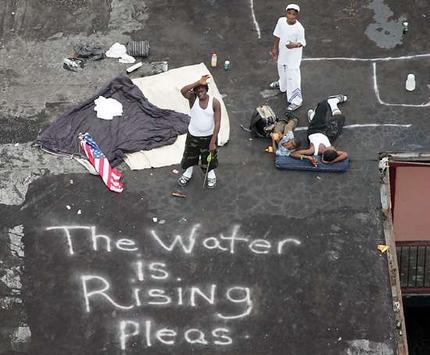
Let’s use a very recent incident: namely, Hurricane Katrina – as an example.

Following this tragic disaster, it wasn’t long before religious fundamentalists piously proclaimed Katrina to be “God’s judgement” upon the “moral sins” of New Orleans (or in some cases, America at large).  This literalist interpretation of the Bible; this victim-blaming for moralistic/political purposes represents the theology at its very worst – and I have no trouble saying so.

However, while this theological approach might fall short as a way to explain random natural disasters, it does serve an important purpose in a different regard: it provides an important reminder of collective responsibility.

After all, beyond all the nasty divine threats in Deuteronomy, there is a more profound underlying message: in society, our choices matter. Regardless of what we believe about God, we cannot ignore the message that our collective actions have very real consequences for ourselves and our world.

So, for example, while many of us refuse to accept that Katrina was a punishment for homosexuality, et al, we cannot deny that much of this tragedy was indeed a result of human failure: for example, the failure of our government to heed reports recommending the repair of decrepit levees, the failure of local, state and national agencies to respond to the disaster promptly and properly, the failure of agencies to keep their promises to aid in rebuilding efforts, etc.

At the end of the day, Deuteronomy’s theology is rooted in the concept of covenant – and more specifically, covenental responsibility. Even if we don’t agree with the literal terms of this covenant as understood by its ancient Near Eastern author, we can still uphold the its essential ideal:

Unless we take our collective responsibility to one another and our world seriously, we may well “perish from the good land” upon which we live.

The Path to Healing is Justice

Your country is desolate; your cities are burned with fire; your land, strangers devour it in your presence, and it is desolate, as overthrown by floods.      (Isaiah 1:6)

These opening verses from Isaiah, are part of the Haftarah portion for this Shabbat.  It is the final of the so-called “Haftarot of Affliction” that precede Tisha B’Av – the most grief-stricken of Jewish festivals.

Like the Biblical book of Lamentations, our Haftarah is filled to overflowing with fierce divine judgement and and overwhelming sense of communal self-pity and shame:

Ah sinful nation! People laden with iniquity! Brood of evildoers! Depraved children! They have forsaken the Lord, Spurned the Holy One of Israel, Turned their backs (on God). (1:4)

Beginning next week, however, our Haftarah portions will offer messages not of affliction, but of healing and consolation. From this point on, these portions will guide us all the way into the High Holiday season itself. In a sense, the Jewish calendar is currently in a spiritual rhythm that moves us on a journey from pain to healing.

I particularly struck that unlike the book of Lamentations, which is essentially a litany of pain and shame, this week’s Haftarah actually offers a quintessentially prophetic call to justice:

Wash yourselves clean; put away your evil from before My eyes; cease to do wrong.

Learn to do good, seek justice; relieve the oppressed. Uphold the orphan’s rights; take up the widow’s cause.   (Isaiah 1:16-17)

In other words, our present woes can be directly traced to our own acts of injustice. As I read these verses, I’m reminded of the oft-made observation that the strength of a society can only be judged by the extent to which it protects its weakest citizens.  In much the same way, this week’s Haftarah teaches that our own vulnerability is irrevocably bound up with the most vulnerable members of our community.

As it turns out, the Haftarah for Yom Kippur comes from the book of Isaiah as well. I like to think of these two prophetic portions as “spiritual bookends” to this season. At the end of the Days of Awe, we will end with the same essential message with which we began – the way to healing and redemption is really quite simple:

No, this is the fast that I desire: to unlock fetters of wickedness and untie the cords of lawlessness; to let the oppressed go free and break off every yoke. It is to share your bread with the hungry, and to take the wretched poor into your home; to clothe when you see the naked, and never forget your own flesh (Isaiah 58:6-7).