who shall live and who shall die

I see you standing there alone

eyes searching through the blankness
of a year stretching limitlessly on like a
book waiting to be written.

Don’t bother glancing behind.
Don’t pretend you’re unaware
that in a year’s time
a world can be shattered
or born anew.

Just gaze forward
and we’ll ask the questions together:
Will it be a year of curse
or a year of blessing?
Of wounding or
of healing?

Throw open your hands and
let your hopes and fears fly out
past the blank pages
of a year yet to be.
Dare to believe that we will all
be written for blessing in
the Book of Sweet, Sweet Life.

Now close your eyes and we’ll send off
this one audacious prayer:
May the new year bless us
with health, wholeness,
and peace.

Slam Poet Tova Benjamin: Not an Envelope Opener

This one is better late than never: Check out 17 year old Chicago slam poet Tova Benjamin perform her poem “I’m Not an Envelope Opener” at Louder Than a Bomb (a Chicago youth slam poetry competition) this past March. Her piece, which powerfully explores her upbringing as an orthodox Jew in West Rogers Park, helped her successfully advance to the final round of competition. Tova was one of the top thirteen individual poets in the festival, out of a field of over 800 young writers.

If you’re interested in learning more about Tova and her work, click here to hear her and another LTAB finalist, Keith Warfield, interviewed on Chicago Public Radio.

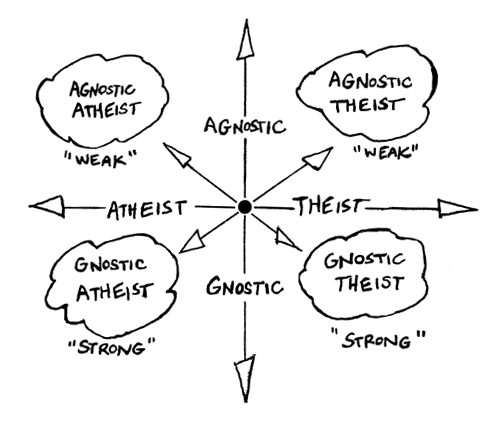
The Varieties of Atheist Experience

If you’re inclined in the non-theist direction, you might be surprised to learn that there are at least as many varieties of atheism as there are forms of religious belief. Check out this really fascinating piece, “Seven Types of Non-Believers” by psychologist and religious journalist Valerie Tarico.

My favorite passage:

Some atheists think of agnostic as a weenie term, because it gets used by people who lack a god-concept but don’t want to offend family members or colleagues … But in reality, the term agnostic represents a range of intellectual positions that have important substance in their own right and can be independent of atheism.

A New Reconstructionist Dialogue on Chosenness

Check out this lovely dialogue on the meaning of “chosenness” in Zeek Magazine by two eloquent Reconstructionist rabbinical colleagues: Rabbis Deborah Waxman and Nancy Fuchs-Kreimer.

Ever since Reconstructionist Judaism’s founder Rabbi Mordecai Kaplan famously (some believe infamously) dispensed of the Chosen People idea from his conception of Jewish theology, its meaning has been a point of lively debate in our movement.  Here’s a taste of how that conversation is playing out now in the 21st century:

Rabbi Waxman:

Rejecting chosenness is an explicit embrace of a modern discourse pointing toward universal truths; it is an articulation of harmonious and consistent principles out of competing voices. Rejecting chosenness is about getting down to the hard work of being one of the many peoples of the world, jostling with one another on the path toward the divine, rather than holding ourselves separate and nurturing a belief in God-given superiority. As postmoderns, we may have the capacity to hold multiple and conflicting values. When it comes to chosenness, I would argue that that we should not indulge in this capacity; by moving beyond chosenness, we make a deliberate statement about our highest values.

Rabbi Fuchs-Kreimer:

(No) matter what I choose in my own religious practice, I cannot simply ignore a core piece of our tradition. The idea of chosenness has not gone away. As a Jew, I still own it, even if I do not speak of it in my prayers. In the interfaith encounter, I have to resist the temptation to claim only the parts of Judaism I love. If I skip over the Jewish ideas I find objectionable or, more often, if I explain that they belong to someone else – “the mistaken Jews” – I am acting in a way that is both arrogant and untrue to my own pluralistic commitments. My dialogue principles require that I learn to understand the beliefs of my co-religionists even when I do not share them.

Moses Hearing Voices

god said to moses i established my
covenant with abraham isaac and jacob to
give them the land of canaan this sounds to me like the
voice of imperial ambition god said to moses i will harden
pharoah’s heart that i may multiply my signs and marvels in
the land of egypt this sounds to me like
the voice of insecurity god said to moses i
have spared you in order that my fame may resound
throughout the world this sounds to me like the voice of
hubris god said to moses lift your rod and
i will strike the nile with the blood of our babies let
it overrun the land of egypt until it rots this sounds to
me like the voice of pain god said to moses i have heard the
cries of the israelites i will free them from their
bondage and set them free to serve an even greater
good this sounds to me like the
voice of god

(Exodus 6:2-6, 7:19, 9:16)

God Felt the Burning

Proxima Centuri - the nearest star to the sun

the israelites cried out to god a
shout hurtling into space shining like a
star that would not die like a luminous
ball of plasma burning on and
on like the thermonuclear fusion of endless boundless
hydrogen that can never be exhausted
light emanating from proxima centauri takes
4.22 light years to be seen on earth it took 400 years
for oppression to transform into
liberation burning white hot but
never consumed

(Exodus 2:23-24)

Monday Morning Quarterbacking on Faith

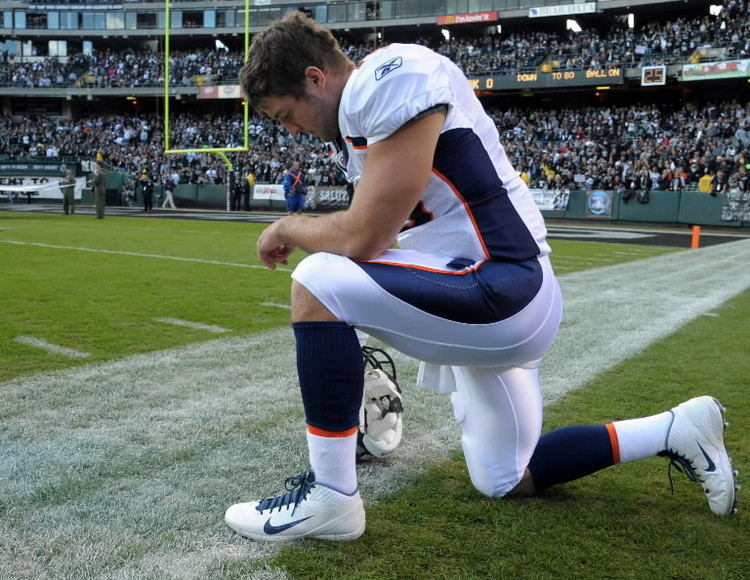
I got into a brief theological kerfuffle in the Twittersphere today over Denver Broncos quarterback Tim Tebow, who openly (and for some, obnoxiously) expresses his evangelical Christian faith. After Tebow led the Broncos to a dramatic overtime win over the Pittsburgh Steelers (and as usual, thanked God for the victory), a friend of mine tweeted:

according to Tebow, God has nothing better to do than help him win football games. Tebow is the Santorum of quarterbacks.

To which I responded:

From a Denver fan pov, it’s not that God wants Tebow to win, it’s that this belief gives him the edge he needs to win games.

My friend then tweeted me back:

Tebow sure doesn’t see it that way. His ostentatious proselytizing is loathsome and contemptible.

My response:

Loathsome and contemptible? I dunno, I don’t agree at all with his politics or theology, but those are pretty strong words. I’d sooner use those words to describe roethlisberger’s behavior than tebow’s…

(Ben Roethlisberger, btw, is the quarterback for the Pittsburgh Steelers, who was accused of sexual assault in 2008 and 2010).

My friend responded to this:

if the best you can say about Tebow is that he’s a better man than Roethlesrapist you’ve made my point for me.

Me:

never said that was the best I could say about him. Only applied ur words more appropriately.

Another Tweeter chimed in:

I can’t fault Tebow for his faith, but I can fault Roethlisberger for his actions.

Further thoughts welcome…

Jacob’s Journey Complete

Auguste Rodin, photograph by Dornac

now israel’s eyes were dim with age he said
i can see the one in whose
steps my father walked even when they led straight
into the fire i see the one who answered
my mother but could not relieve her
pain i can see so plainly my own reflection masked
and unmasked deceiver and deceived ascending
descending wrestling embracing fleeing
returning yes i see quite clearly these scarred and
withered hands are the hands of jacob but the face is
the face of god when he was ready to stop
struggling jacob drew his feet into the bed
breathed his last breath
and finally returned
home

(Genesis 48:10, 49:33)

Honoring the Bridgers of Science and Religion

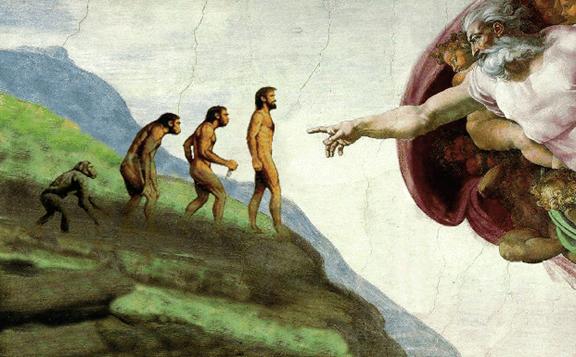
Among the plethora of “Top Ten of 2011” lists out there, one of the most interesting I’ve read was written by Paul Wallace for Religion Dispatches: “Top Ten Peacemakers in the Science-Religion Wars.” According to Wallace, 2011 may well have marked the beginning of the end of the conflict between science and religion – and to prove his point, he spotlights ten figures who, “in small ways and large, have helped to spread seeds of peace on (this) blasted-out battleground.”

His remarkably diverse and wide ranging list includes the likes of Republican presidential candidate Jon Hunstman (a devout Mormon who – gasp – openly supports the scientific findings on climate change), comedian Jon Stewart (who took on the political orthodoxies of American Atheists), film director Terence Malick (director of “The Tree of Life”) and Nidhal Guessoum (a prominent Muslim astrophysicist.)

Here’s Wallace’s take on Malick’s “Tree of Life” – a particularly lovely meditation on the often sublime intersection of religion and science:

It is indeed a strange and beautiful world. Malick, in his graceful and courageous film, reminds us that it is made stranger and more beautiful the more we open ourselves to it.

Both the closed-hearted scientism of atheist hardliners and the narrow creationism of religious fundamentalists kill our strange and beautiful world by flattening it beyond repair. They deny its depth and mystery. Malick, in joyous contrast, has shown us—through art and not through argument—just how wondrous and surprising it is to live life out here in the middle.

And for helpful insights on this important subject from a Jewish point of view, I commend to you this June 2011 post by Rabbi/blogger Geoffrey Mitelman:

Science is about creating hypotheses and testing data against these theories. Judaism is about how we act to improve this world, here and now. And these processes can easily go hand in hand.

So yes, if science and religion are seen to be competing sources of truth and authority, they will always be in conflict — especially if religion is “blind acceptance and complete certainty about silly, superstitious fantasies.” But if instead, religion is about helping people create a deeper sense of meaning and a stronger sense of their values, then I truly believe that science and religion can be brought together to improve ourselves, our society and our world.