psalm 27: my light and my hope

sedona-sunset


you are my light and my hope
why should i fear?
you are my life and my strength
why do i tremble?

when i contemplate surrender
to my dread of the unknown,
i hold tight to you
and your strength gives me strength.

i only ask one thing of you,
just this one thing:
that i may be welcome in your house
all the days of my life,
to dwell in your innermost place
beneath the softness of your wings.

I seek your shelter
when i am wracked by hardship and disquiet;
from your deepest depths
I will sing hymns to the darkness
with openness and love

do you hear my song?
don’t you hear me when I cry to you?
do not turn away –
i seek you endlessly,
i turn constantly toward your light.

even in my darkest moments
of this i am sure:
I am never alone,
yes, even if my father and mother
abandoned me, I know you are there
to gather me up

guide me in your ways,
lead me down the paths
of wholeness and peace,
remind me that no matter
how far i may stray
there is always a road
to return.

though i don’t always see it
i will trust in your goodness
right here, right now
in the land of the living.

hold on to your hope
and be strong –
the season of our return
is at hand.

psalm 23: filled to overflowing

photo credit: commons.wikimedia.org

photo credit: commons.wikimedia.org

though i am pursued by
my desires,
i lack for nothing.

you shepherd me
past all want;
you take me through lush pastures,
you bathe me in still waters
and replenish my spirit.

you guide me into
wide open vistas and
lead me through valleys
of deepest darkness;
my steps fall sure
and true.

you set my life before me
as a sumptuous banquet;
i feast on your goodness,
and am filled to overflowing.

even when hunger grips
my soul,
i know you are near;
coaxing me back,
drawing me close,
beckoning me
home.

psalm 14: some questions for the faithful

iam

i’m so tired tired of loving you
like a scared and lonely child, so
desperate to behave,
to follow the rules,
to say the right words, to
think proper thoughts.

so i can’t help but ask:
is it better to surrender or to obey?
to fear or to be afraid?
to serve or to live in servitude?

should i try to believe in you
or accept that you are
existence itself?

psalm 13: the grief of one shattered heart

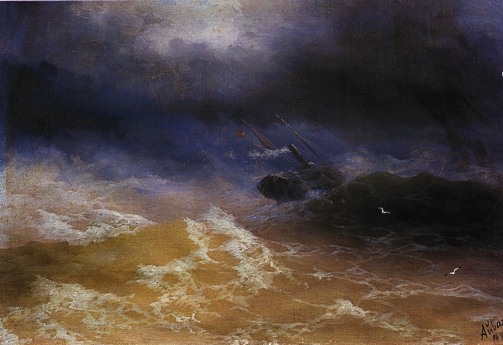
"Storm at Sea," Ivan Aivasovsky (1899)

“Storm at Sea,” Ivan Aivasovsky (1899)

in such a vast universe
can you even feel
the grief of
one shattered heart?
do I dare presume
it might even make
a difference?

please don’t turn away,
don’t fill my life with disregard,
don’t let my grief drift like
a battered wanderer
refused sanctuary at
every turn.

i’m not praying for rescue
for i know this brokenness
is mine to bear.
i pray only for the faith
that somehow you can hear
this sad song
and that in some small way
it matters
to you.

psalm 12: silver strings

silver strings
so much need
in the world and
so much talk,
so many kind
duplicitous words
in response to
so much deprivation
and want.

don’t let me fall
into the speech of
of the pleasant and
cynical,
from the words that
serve only to increase
my own comfort while
keeping the pain of
others at bay.

teach me to speak
your truth:
words that resonate like
a silver string
forged and refined to
utmost purity,
words that pierce the
hard shell of equivocation,
words that reverberate
with raw precision,
words that create
whole worlds
anew.

psalm 9: the oppressed are your chosen

Women's liberation rally in Miami, 1972. (Abbas/Magnum Photos)

Women’s liberation rally in Miami, 1972. (Abbas/Magnum Photos)

the oppressed are your chosen –
their cries
hymns of praise to
the source of liberation.

whenever you hear our sad
psalms of despair, the
dirges that affirm that
persecution is our destiny,
turn us
show us the arc of history
that bends inevitably
toward justice.

open our eyes to
the graveyards of nations
whose oppression has
rebounded upon them
whose insatiable desire was
their final ruination.

help us to understand the source
of our true power –
not in the flame of human cruelty that
inevitably flickers and dies,
but in the inexhaustible fire
that burns in the hearts
of all who struggle
to be free.

Tu B’shvat in the Diaspora: Celebrating the Unseen

snowtrees

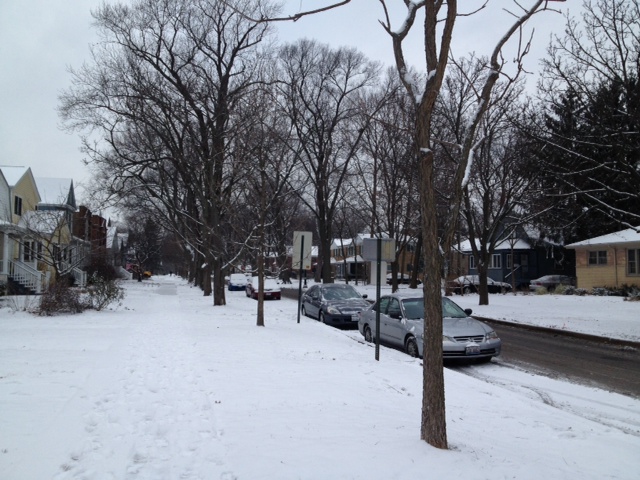
In the land of Israel, the “harbinger of Spring” festival of Tu B’shvat is marked at this time of year by the blossoming of the white almond blossoms through the central and northern parts of the land. Those of us, however, who live in the northern hemisphere diaspora, often celebrate Tu B’shvat surrounded by several inches of white snow and leaf-less trees. Is this any way to celebrate a harbinger of Spring?

I’ll suggest that it is. I actually find it very profound to contemplate the coming of Spring in the depths of a Chicago winter. It reminds me that even during this dark, cold season, there are unseen forces at work preparing our world for renewal and rebirth. Deep beneath the ground, the sap is beginning to rise in the roots of our trees – although this fructification process might not be as visually spectacular as the proliferation of white almond blossoms exploding across the countryside, I believe this invisible life-giving energy is eminently worth acknowledging – and celebrating.

I took the picture above this morning while walking my dog.  They may not be gorgeous almond blossoms, but I’d like to think that these bare, snow covered elms are wonderful spiritual teachers in their own right. All hail the unseen forces of our rebirth and Happy Tu B’shvat!

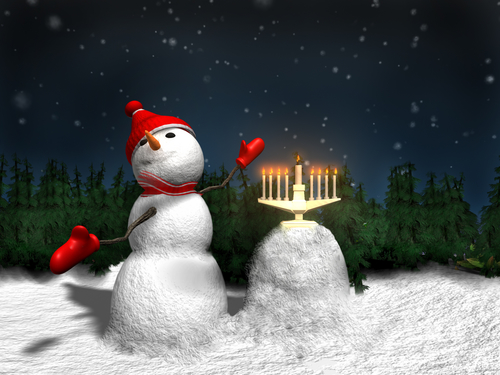
Yes Virginia, Maybe Hanukkah IS the Jewish Christmas…

Christmas-Hanukkah

Among the most interesting and smart articles I’ve read about Hanukkah this year is a piece by JTS Rabbinical Student Benjamin Resnick in the Forward, in which he argues there is every reason – and in fact good historical precedence – for Jews to appreciate the beauty of Christmas even as they celebrate Hanukkah.

Resnick writes:

I say this as a committed, observant Jew and as a future rabbi. As someone who spends a great deal of time engaged in ritual, there are a handful of ritual moments that — year in and year out, and regardless of where I am physically, emotionally or spiritually — never fail to move me. The beginning of ma’ariv on the first night of Rosh Hashanah, is one. The smell of latkes is another. And the first time I hear the rum-pum-pum-pum of “The Little Drummer Boy“ is a third.

The fact is that Hanukkah menorahs and Christmas trees, “Maoz Tzur” and “Jingle Bell Rock,” potato pancakes and chow mein have become intertwined in the seasonal consciousness of American Jews. And while a great many contemporary Jewish voices go to great lengths to convince us that Hanukkah is not the “Jewish Christmas,” I would argue, from both a historical perspective and a spiritual one, that such protestations do a disservice to the very traditions they venerate.

I actually came out of this particular closet (admittedly in a much less erudite manner) several years ago when I confessed that I love listening to Christmas songs – particularly those of the aching, melancholic variety:

Is it perverse or at all sacreligious for a rabbi to be confessing his love for songs such as these? I dunno, don’t you think there’s something of a Jewish quality to them? Maybe it’s their quasi-exilic yearning (not to mention the fact that most of them were written by Jews anyhow.)

So that’s my seasonal guilty pleasure confession. And lest you judge me too quickly here, just take the test yourself. Check out James Taylor’s version of “Have Yourself a Merry Little Christmas” or “I’ll Be Home For Christmas” as sung by Sarah McLachlan. (Man, that last line gets me every time…)

So have yourself a Happy Little Hanukkah now…

jacob at the well of souls

Photo by Bart Bernardes

as soon as jacob rolled the stone
away it all came bursting forth like
the waters of a long forgotten spring he
he told her of his sorrow and
his fear his shame and
regret all the dreams
he dared not recall
in the light of day

when rachel took him to her father’s
house laban ran out and embraced him
jacob told him of his journey laban
smiled and tightened his grip
my god you’ve got your mother’s eyes
then leading him into his house he added
i believe the two of us
are going to get
along just
fine

(Genesis 29:1-14)

separation

when he felt himself being
separated he held fast to
his twin gripping tighter the
pressure slowly tearing them
apart with growing
terror he realized the presence
of a force much more powerful was
upending this exquisite balance
he heard a far off voice pleading
but if so then why do
i exist?

when he felt him pulling
away he reached out
but could only grab hold of
his heel that’s
how they came into
the world esau
howling in the blinding
light and jacob whose
name means the one
who refused
to let go

(Genesis 25: 2-26)