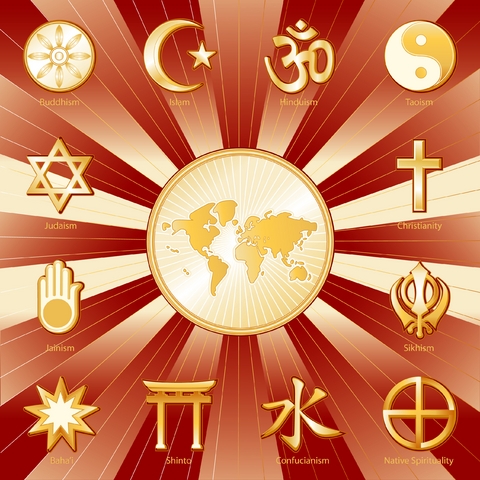
According to a 2009 Pew study:
The religious beliefs and practices of Americans do not fit neatly into conventional categories. A new poll by the Pew Research Center’s Forum on Religion & Public Life finds that large numbers of Americans engage in multiple religious practices, mixing elements of diverse traditions. Many say they attend worship services of more than one faith or denomination — even when they are not traveling or going to special events like weddings and funerals… One-third of Americans (35%) say they regularly (9%) or occasionally (26%) attend religious services at more than one place, and most of these (24% of the public overall) indicate that they sometimes attend religious services of a faith different from their own.
A welcome phenomenon? U. of Miami religious studies professor (and Christian liberation theologian) Ivan Petrella says yes:
We’re a nation moving beyond religious pluralism. A religiously plural nation is a multi-religious nation, one where religions peacefully coexist. But within pluralism, religions are still watertight compartments. People aren’t allowed to belong to more than one or to borrow the ideas and practices of another, without feeling like they’re traitors to their faith. That’s changed. In our emerging religious reality people are shattering the compartments and becoming multi-religious. We’re no longer just a multi-religious nation. We’re a nation of multi-religious people…
The United States has always thought of itself as a great experiment. Let’s not be shy about experimenting with multiple faiths as well.
Another well-known professor of religion, Steven Prothero, begs to differ, saying there are just too many important differences between religions – and our tendency to sample a bit of each smacks uncomfortably of American consumerism:
At their best, Judaism and Christianity and Hinduism and Buddhism call us to rethink the world and then challenge us to remake it—and to remake ourselves. But the truths of one religion often clash with those of others, or contradict each other outright. Even Protestantism has carried inside its various denominations strikingly different visions of the good life, both here and in the hereafter. Absent a chain of memory that ties us to these religions’ ancient truths, these visions are lost, and we are left to our own devices, searching for God with as much confusion as we search, in love, for the next new thing.
Theological student Yaira Robinson concurs, using the metaphor of language to understand the importance of exclusive religious affiliation:
In order to communicate effectively, though, you can only speak only one language at a time. When you mix and match language systems—throwing in vocabulary from other languages, re-arranging the grammar, tossing in foreign idioms—then communication becomes difficult. Likewise, each religious system is a coherent whole, with all its parts—stories, history, prophets, teachings, and practices—working together to facilitate communication. This is the beauty of speaking one religious language, of walking one religious path—doing so can bring our lives into a clearer relationship with God.
What say you? I’m curious to hear your thoughts!







 Yedid Nefesh